units issaian_epibatai - RTR-Imperium-Surrectum/ris-wiki GitHub Wiki
Class: missile · Category: infantry · Men per unit: 40
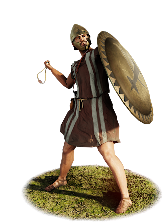
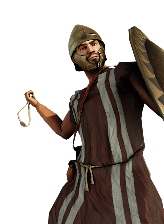
Issaian Epibatai are the marines of the polis of Issa. Their mastery of the sling can be devastating to your opponents. When in close combat, these Epibatai switch to their curved machaira swords. For protection, they trust on their large wooden aspides shields covered with bronze. This weaponry makes them durable as both skirmishers and supporting infantry. They wear bronze helmets that cover a large part of the head. Some of the men wear the common Pilos helmets, with or without wide brims that shade the eyes; others prefer the impressive regional feathered helmets. Epibatai should open the battle, seeking out and hurling rocks at opposing skirmishers and archers. Thanks to their large shields, they can run inside the range of unarmoured archers and take them out in a prolonged skirmish. These Epibatai do not wear armour, as this would make them unable to swim if they fell into the sea. This also allows them to swim across rivers during battle.
In the Hellenic world of the 3rd century BC, fleets were vital to support armies, defend trade routes, and to raid enemy lands. The city of Issa had a capable fleet that protected its island and controlled the shipping in the Adriatic sea. Fleets tried to outmanoeuvre and ram the opposing ships while pelting the enemy with stones, arrows, and spears, but if that did not work the Epibatai (“Marines”) had to conduct boarding operations using swords. We know that the Chians assigned 40 wealthy citizens as Epibatai to each of their ships during the Ionian Revolt (499-493 BC) (Hdt. 6.15.2) and the Athenians only put ten Epibatai on their trieres during the Peloponnesian War (431-402 BC). It depended on the winds, types of ships, and the tactics employed how many Epibatai would be seated on one vessel. Ten Epibatai per ship was probably the norm (Herzogenrat-Amelung, Naval Hoplites (2017), pp. 46-49). If the fight was in a harbour, a narrow space, or a landing action, more Epibatai would be embarked. Thucydides quotes the Athenian commander Nikias making such a consideration: “A number of archers and darters will go on board, and a multitude that we should not have employed in an action in the open sea, where our science would be crippled by the weight of the vessels; but in the present land-fight that we are forced to make from shipboard all this will be useful” (Thuc. 7.62.2). The Epibatai were free men who commanded and controlled the sailors on the loud and unruly sea (Thuc. 2.84; Herzogenrat-Amelung (2017), p. 53).
The Issaian Epibatai do not wear any armour, as a linothorax would be their undoing if they would fall into the sea (Ioannidou, Hellenic Marine Forces in Late Bronze Age Greece (2018), p. 10 & Herzogenrat-Amelung (2017), p. 47). The armour would start to suck in water and become increasingly heavy, hence it would equally be a death trap, and the same is true for greaves. Moreover, no body armour is attested in Illyria in the Hellenistic period (see other Illyrian units). Hence, these Epibatai have abandoned all other forms of armour but for their bronze Illyrian and pilos helmets, and large aspis shields. These shields were held by an armband (porpax) right before the left elbow, while the hand gripped a leather handle (antilabe). This enabled the Epibatai to support the weight (on average 6.2 kg or 13.7 pounds) on both the elbow and the wrist. This mechanism also made it possible to use shield and sling at the same time. The shield was not very thick, however, reducing its effectiveness against arrows and javelins (Fink, The Battle of Marathon in Scholarship (2014), pp. 31-34). Therefore, some skirmishers would prefer a smaller shield. Epibatai, however, were expected to fight in melee as light infantry, and therefore preferred the aspis.
Greek slingers used a long sling, and in war the ammunition was ideally lead shot, weighing around 0.7-1.05 ounces (20-30 grammes) but occasionally up to 1.9 ounces (55 grammes). Sling missiles would usually be carried in the fold of the cloak, behind the shield or in special pouches. Bullets were often inscribed with the name of the commander (Echols, ‘The Ancient Slinger’ (1950), pp. 227-228). Such leaden bullets were shaped like an almond, tapering to a dull point at the end, which gave the bullet a whirling motion that increased its penetrating power. This lead shot easily outranged the stone shot of the Persian slingers and sometimes even the range of their archers (Xen. Anab. 3.4.18). As melee weapons the Issaians used the curved iron machaira, which is most similar to the famous Illyrian sica. The weapon’s name is related to μαΧη (mákhe) Greek for "a battle" and μαΧεσθαι (mákhesthai) "to fight". As a one-edged weapon, the sword is used for cutting the opponent like an axe, rather than trying to thrust, although the possibility is there. Excavated machaira swords measure from 35 cm to 77 cm long (Everson, Warfare in Ancient Greece (2004), p. 125). The longer versions were used by cavalrymen. Infantry used swords that were usually smaller than 50 cm.
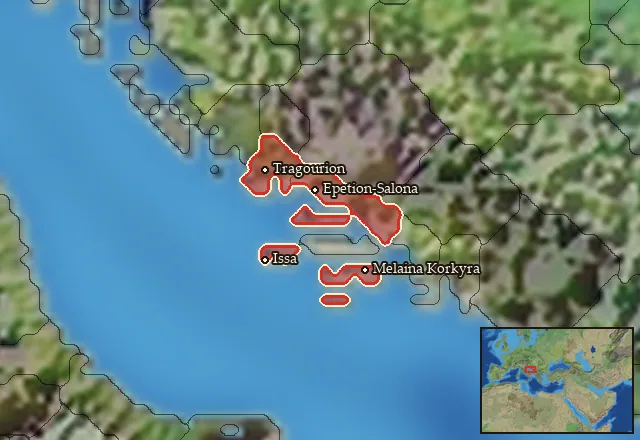
The city of Issa was founded by Dionysios I (r. 405-367 BC), tyrant of Syracuse, in 385 BC as a basis for Syracusan operations in the Adriatic (cf. Diod. 15.13.3, 14.2; Stroheker, Dionysios (1958), pp. 123-124; Ps-Scymn. 413-414). Dionysius wanted to secure (Syracusan) trade routes along the Adriatic. To this end, Epibatai were most likely stationed in the polis. The settlement was built on a slope that overlooked the northern part of the island of Vis, as it is known today. As a naval port, it will have been equipped with military facilities from early on, and a massive stone wall was erected around the city (Mohorovičić, Architecture in Croatia (1994), p. 42). The walls enclosed an area of 100.000m² (119,599 square Yards), in which several thousands of people lived, while the whole island was dotted with farms and villages (Zaninović, M., Issa, in: The Princeton Encyclopedia of Classical Sites (1976), 417). Issa was a polis, but it was dependent on its mother city and ruled by an eparchos, a local governor (Fischer-Hansen/Wilkes, The Adriatic (2004), p. 332). The economic (naval) power of Issa is attested by its foundation of a colonies, fortresses and trade posts on Melaina Korkyra (modern Korčula, Sylloge Inscriptionum Graecarum: 141), Salona (now Split, cf. Fellmeth, Ulrich, s.v. Salona, in: DNP Online), Epetion (Polyb. 32.9.1) and Tragourion (Strab. 7.5.5C315) and other places on the coast of the Dalmatian mainland. Together, they formed a “commonwealth” under Issa’s leadership (Džino, Illyricum in Roman Politics (2010), p. 50). Since all major trade routes between Magna Graecia and the Dalmatian hinterland went through Issa - and no other Adriatic island - from the beginning of the 3rd century BC, the commonwealth developed into a major commercial power (Derow, Kleemporos (1973), 125-126).
The golden age of Issa, like so many others, came to an end during the Roman civil wars. First in the camp of Caesar, Issa sided with Pompey after Marcus Octavius had persuaded the Dalmatians (Caes. Civ. 3.9). Only the council of the Issaian colony of Salona was, however, unimpressed and drove off the Pompeian force besieging them. It is likely that the growth of Salona started a rivalry with its mother city Issa over influence and leadership within the commonwealth. The Caesarian faction got the upper hand in 47 BC, when the Pompeian fleet under Marcus Octavius was defeated near the island of Taurike. Salona, which had previously rebelled against its mother city and had remained loyal to Caesar, was now given the role of capital of the province of Dalmatia (Džino (2010), pp. 91-96). Thus ended the independence of Issa after 300 years. Their fate echoed that of Massalia in Gaul. The southern city wall of Issa was removed. Not long after, the Issaians and their colonies gained Roman citizenship, and were added to the administration in Salona (Džino (2010), p. 121).
| Rank in roster | ||
|---|---|---|
| Men per unit | 40 |
███······· 30% |
| Attack | 7 |
█········· 6% |
| Charge bonus | 10 |
████······ 35% |
| Defence | 29 |
████······ 40% |
| · armour | 3 |
██········ 21% |
| · defence skill | 21 |
█████····· 54% |
| · shield | 5 |
██████···· 57% |
| Morale | 11 |
████······ 39% |
| Discipline | Normal | |
| Training | Trained | |
| Recruitment cost | 1,866 dn |
████······ 42% |
| Upkeep per turn | 683 dn |
██████···· 63% |
| Turns to recruit | 3 |
Its secondary attack is the stronger one: 10 against 7.
| Primary | Secondary | |
|---|---|---|
| Attack | 7 | 10 |
| Charge bonus | 10 | 11 |
| Type | missile · archery | melee · blade |
| Damage | blunt | piercing |
| Projectile | stone | — |
| Range | 150 | — |
| Ammunition | 27 | — |
| Primary | Secondary | |
|---|---|---|
| Total | 29 | — |
| Armour | 3 | — |
| Defence skill | 21 | — |
| Shield | 5 | — |
| Hit points | 1 |
| Ground: scrub / sand / forest / snow | 0 / 0 / 0 / 0 |
| Charge distance | 30 |
| Formations | Square |
Technical stats
| Time between blows (primary / secondary) | 2.5 s / 2.5 s |
| Extra fatigue in hot climates | 0 |
| Collision mass per man (1.0 is normal) | 0.95 |
| Spacing between men: close / loose | 1.2 × 1.4 m / 2.4 × 2.8 m |
| Default ranks | 5 |
In battle: Can sap · Very good stamina
A core roster unit for one faction, which can raise it anywhere it holds the right building:
Any faction holding one of the provinces below can field it.
Exactly what a settlement must have, route by route (5)
| Zone | Provinces |
|---|---|
| Issaian | 4 |