Home - SteveJustin1963/radio-fax-Hellschreiber GitHub Wiki
Hellschreiber
is a machine-readable teleprinter code that was used in the early days of telecommunications.
It was invented in 1918 by Rudolf Hell, a German engineer. Hellschreiber was used extensively during World War II by the German military. After the war, Hellschreiber fell out of use in favor of more modern teleprinter codes such as Baudot and ASCII. However, it has experienced a resurgence in recent years as a means of sending text messages over amateur radio.
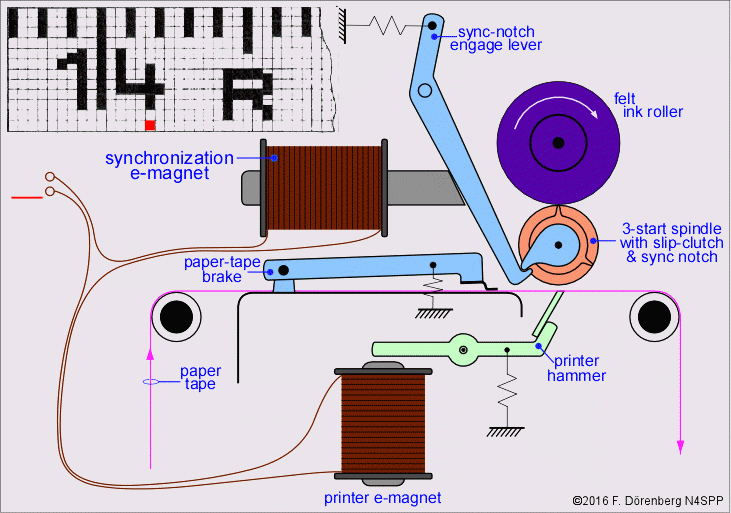
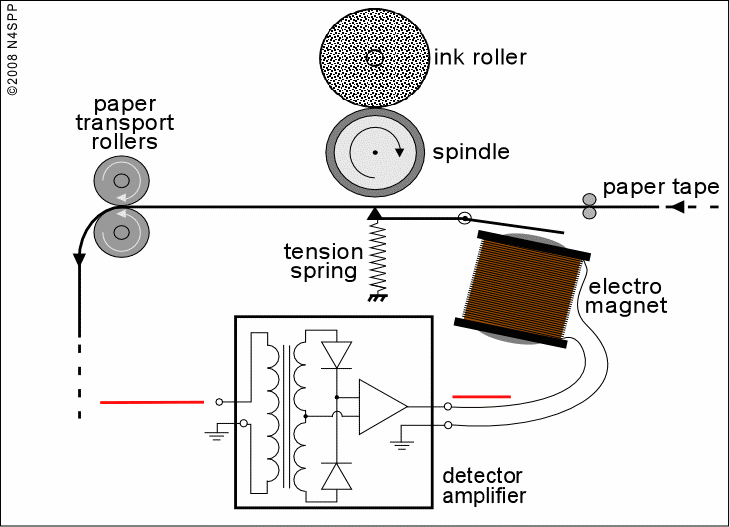
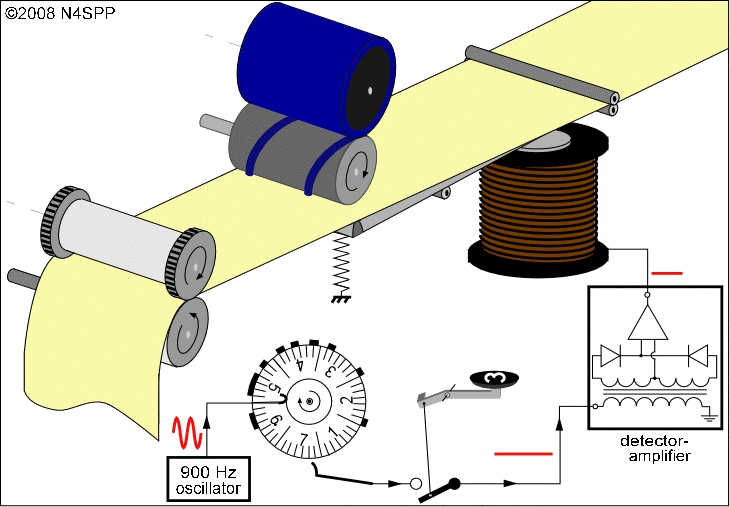
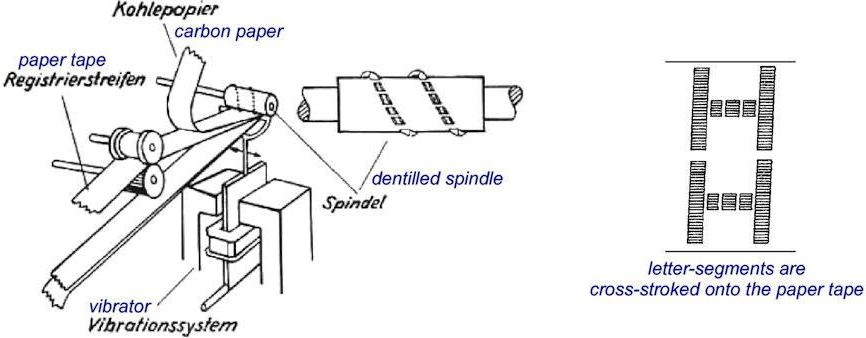
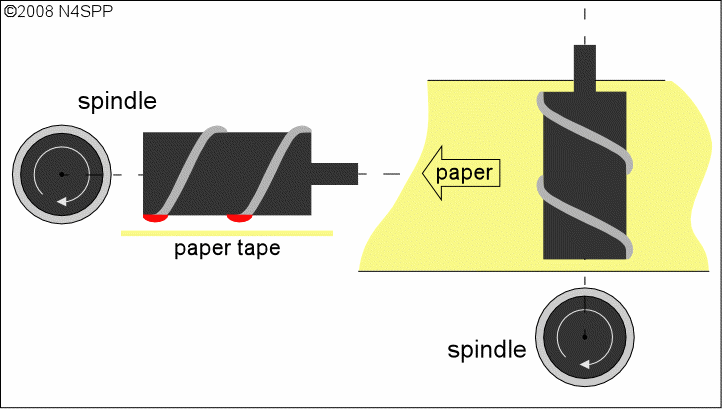
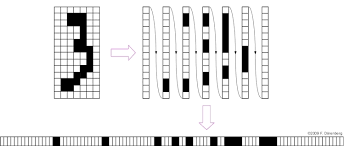
Hellschreiber transmits each character as a series of dots and dashes. The code is read by a machine that prints out the characters on a sheet of paper.
One advantage of Hellschreiber over other teleprinter codes is that it can be used with a simple Morse code keyer. This makes it ideal for use in amateur radio communications.
Hellschreiber is also less susceptible to interference than other teleprinter codes. This is because the dots and dashes are printed on the paper, rather than being transmitted electronically.
What are the disadvantages of Hellschreiber?
- it is slower than other teleprinter codes. This is because each character must be transmitted as a series of dots and dashes.
- not as widely used as other teleprinter codes. This means that there are fewer people who are able to read and write the code.


variants
- PSK Hell encodes a pixel's brightness in the carrier phase instead of the amplitude. it's encoded in the change of the phase (differential phase shift keying): an unchanged phase in the beginning of a pixel means white, and a reversed phase means black. It operates at 105 or 245 baud.
- FM Hell (or FSK Hell) uses frequency modulation with a careful control of phase, essentially minimum-shift keying. The most common variant is FSK Hell-105.
- Duplo Hell is a dual tone mode which sends two columns at a time at different frequencies (980 Hz and 1225/1470 Hz).
- C/MT Hell or concurrent multitone Hell sends all rows at the same time using tones at different frequencies. The transmission can be read using an FFT display. It allows for high resolutions.
- S/MT Hell or sequential multitone Hell is like C/MT but it sends only one tone (for one row) at a time. As a result, characters received have a bit of slant, they look like an oblique font. This is similar to a Hellschreiber using a mechanical font.
- Slowfeld, experimental narrow band Hellschreiber principle – transmitter / receiver use the same column-scan speed. Data is sent at a very slow rate and received via a Fast Fourier Transform routine giving a bandwidth of several Hz. As long as tuning is within several signal bandwidths, the result will appear. The transmission rate is around 3, 1.5 and 0.75 characters per second. Slowfeld, along with similar modes such as very slow QRSS Morse code, may be used when all other communication methods fail.