Water - SethKitchen/ThreeMojo GitHub Wiki
Water
render_water draws one Clearwater still of shallow water.
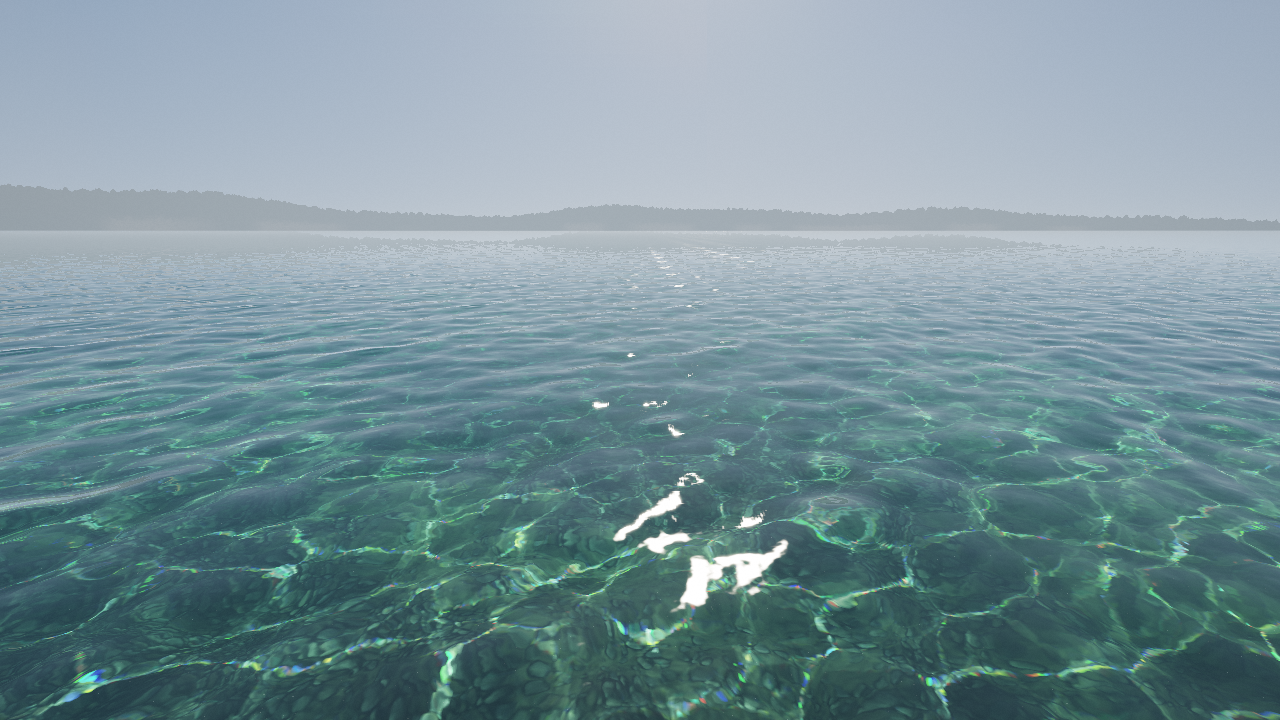
The modules live in extensions/water/. This is a port of Clearwater by Aurélien Gimazane (Lumaris, 2026, MIT). See Extensions.
bed_color repeats assets/pebbles.jpg. It then mixes sand, coarse cobble and weed.
Call it
from extensions.water.frame import render_water
from extensions.water.pebbles import pebble_bed
from extensions.water.resolution import SpectrumResolution
from extensions.water.view import FRAME
from render.jpeg import decode
from std.pathlib import Path
from units.si import RADIAN, SECOND, Angle, Duration

var bed = pebble_bed(decode(Path("assets/pebbles.jpg").read_bytes()))
var image = render_water(
    1280,
    720,
    Duration(5.0, SECOND),
    FRAME,
    False,
    SpectrumResolution(256),
    64,
    256,
    SpectrumResolution(128),
    False,
    bed,
    Angle(-0.22, RADIAN),
)
False holds the camera still. The next False leaves the ripple window empty. The pitch is -0.22 radians, so the headland matches the photograph. The page starts at -0.72 radians.
Animate it
Use a WaterScene to draw more than one frame. The scene keeps the resources that do not change with time. It builds the ocean spectrum once. It builds the glare kernels on the first frame that needs them. It owns the ripple window and the clock.
from extensions.water.frame import WaterScene

var scene = WaterScene(
    SpectrumResolution(64),
    32,
    128,
    SpectrumResolution(64),
    Duration(0.0, SECOND),
)
for frame in range(60):
    scene.advance(Duration(1.0 / 30.0, SECOND), frame % 10 == 0)
    var image = scene.draw(320, 180, FRAME, True, bed, Angle(-0.72, RADIAN))
advance steps the ripple equation once, then moves the clock. Its Bool taps the middle of the ripple window. The step must be finite and nonnegative. The resulting clock must also be finite. A refused step leaves the ripples, clock and step count unchanged.
draw makes a picture at the scene's clock and does not change the simulation. Equal steps give equal pictures.
The start clock must be finite. Finite negative start times are valid. WaterScene checks the start before it builds resources. This also makes render_water refuse nonfinite time. Earlier versions could propagate a nonfinite time into the picture. Valid finite times keep the same arithmetic and step order.
reset returns the ripples and the clock to the start. It keeps the spectrum and the glare kernels. The buffers keep their sizes for the life of the scene.
render_water is one scene step and one draw.
Compose it with a scene
Use compose to put the water into a picture that the renderer made. Pass the rendered framebuffer, the updated scene, its camera and the height of the still water. An attached camera uses its node and parent transforms.
var image = renderer.render(scene, assets, camera)
var shown = water.compose(image, scene, camera, Length(0.0, METER), bed)
The overload without a scene accepts detached cameras. An attached camera with a stale scene or invalid node is refused before any pixels or depths change. Update the scene before rendering and composing.
Each pixel casts the camera's own ray. A ray that reaches the water shades it as the LINEAR picture does. Its depth is then tested against the framebuffer.
Geometry nearer than the water keeps its pixel. Water nearer than the geometry replaces the pixel and writes its depth. A ray at or above the horizon leaves the pixel alone. compose returns how many pixels show water.
The water is an endless plane at the given height. It repeats the ocean patch. The camera must be a centered perspective camera above the water. Water nearer than the near plane or past the far plane is not drawn. With the page's camera, compose gives the LINEAR picture below the horizon.
set_sun lights the water from a scene's directional light. Pass the light's position minus its target. The direction must be finite and above the horizon. The default is Clearwater's sun. The sun lights the reflections, the bed and the caustics.
The water shades the pebble bed under the surface, not the scene's geometry under the water. compose shades on the CPU. See Shade it on a GPU for the GPU shading path.
Pictures
WaterView names four pictures.
| Name | What it draws |
|---|---|
FRAME |
The graded photograph. |
CAUSTICS |
The caustic texture, scaled by 0.25. |
LINEAR |
The water without glare or bloom. |
GLARE |
The diffraction spikes alone. |
Grid
SpectrumResolution is a power of two from 4 through 256. The still uses 256, the same ocean grid as the page. The patch is 4.6 meters. The mean depth is 1.6 meters. The root-mean-square slope is 0.078. Mipmaps and anisotropy filter the ocean, the caustics and the pebbles.
The caustic grid in the still is 64. The page uses 256.
Frame
render_water builds a WaterScene, steps the ripple and draws the caustics. It then shades each pixel and grades the color. The shader clock is 0.9 times the frame clock. Dispersion repeats every 60 seconds of shader time.
Sampling and light transport
Texture coordinates name texel centers at (i + 0.5) / n, as in WebGL. Bilinear, cubic and mip samples use the same convention. Caustic triangles use a half-open edge rule, so a shared edge receives light once. A flat surface under a vertical sun has unit caustic intensity.
Underwater absorption and ripple lookup follow the refracted sun direction. The sun is not treated as vertical when it is near the horizon. Invalid spectrum and glare sizes are refused before their grids are allocated.
Shade it on a GPU
GpuWater in extensions/water/gpu.mojo runs lit_radiance with one thread for each pixel. It needs MAX and a GPU, and it refuses a machine without one. It runs on NVIDIA CUDA and on Apple Metal. It was run on a TITAN RTX and on an Apple M4 Max. CI builds it for sm_80, and make check-gpu-air checks its Metal calls.
Make one with the pebble photograph, which it copies to the device once. Then use the same calls as WaterScene:
draw(scene, width, height, view, sway, pitch)draws a whole picture. Bloom, glare and grading run on the CPU.compose(scene, image, world, camera, water_level)composes water into a rendered scene. It shades on the GPU before it changes the image, so a failed frame leaves the image whole. The depth test and the write run on the CPU.radiance(scene, look, width, height)returns the linear radiance, three floats a pixel.
Each frame copies the surface, the ripple window and the caustics to the device. It waits for the device on every exit, success or failure, before it frees its host copies. Dropping a GpuWater waits for the device, then frees its buffers and its context.
The GPU result is not bit-identical to the CPU result. The device fuses multiplies and adds, and its math functions round differently. A last-bit change can flip an anisotropic tap count, a mip clamp or a noise band. tests/test_gpu_water.mojo requires every value to be finite. It requires 98 percent of values within 1 percent of the CPU, 99.5 percent within 10 percent, and none beyond 2.
See the GPU water report. On that GPU a 1920 x 1080 shade takes about 41 to 76 milliseconds. A whole water frame takes about 255 milliseconds, because bloom, glare and grading take about 154 on the CPU. A composed scene takes about 247. The depth pass, the highlight and blur passes, and the grade and write run on every logical core.
On an Apple M4 Max with Metal, a 1920 x 1080 shade takes about 71 milliseconds. A whole water frame takes about 168, and a composed scene about 174.
Shader storage
lit_radiance shades one view ray. It reads every texture through four traits: SurfaceTexels, RippleTexels, CausticTexels and PebbleTexels. The water fields implement them, so draw and compose call it directly.
A WaterPack copies one frame's textures into flat float arrays, with a table of mip levels for each. Its views implement the same traits, and their address space is a parameter. A GPU kernel can read the same arrays in device memory and call lit_radiance. A view does not keep its pack alive. Use the pack after the last read through a view.
The CPU and a device shade with the same arithmetic. The sky azimuth uses atan2_float32 from math/arc_tangent.mojo, because a GPU has no libm. The field of view uses the stored bits of the host's tan(32°).
The shader uses no Float64, because Apple GPUs have none.
hash12 rounds each step to Float32 once, so a fused multiply-add cannot change the hash. Each product is an fma with a zero addend: it rounds once, and no compiler fuses it into the next add. So the CPU and a GPU give the same hash bits. tests/test_gpu_water.mojo compares them bit for bit. The water sine is sin_float32 from math/sine.mojo, which gives the same bits on a CPU and a GPU at every angle. A compiler can fuse other multiplies and adds differently for each storage type, so the last bits of a pixel can differ.
This extension draws a CPU still. It is not a shared scene-water object or a validated fluid solver. The picture does not establish a real-time frame rate, buoyancy, or engineering fluid accuracy.
Cost
draw shades and grades disjoint runs of rows on every logical core. Each pixel keeps the serial arithmetic, so the picture does not change. compose runs its depth test first, by disjoint runs of rows. It then shades only the pixels that pass, in parallel.
Set WaterScene.workers to control how each pass is cut into tasks. Zero, the default, sizes the cut for every logical core. One runs each pass serially, as one task. A larger count makes more tasks, but the shared thread pool decides how many run at once, so the count is not a thread limit. Every count draws the same picture.
On an AMD Ryzen 9 5900X, a 1920 x 1080 draw takes about 1.7 seconds. On one thread it took about 18 seconds. One advance takes about 12 milliseconds. The CPU path therefore cannot reach 60 frames per second at that size. See the water cost report and bench/water_bench.mojo.