Resonant ferrite rod antenna - SA5NNN/VLF-Receiver GitHub Wiki
The ferrite rod antenna is a resonant construction, the parts for the schematics to look out for is:
 Figure 1
The diodes are special diodes designed to provide capacitance as the forward voltage increase. They are called varactors or varicaps. Since they require DC to regulate the capacitance, capacitor C3 is added to block the DC from entering the rest of the circuit. If we decide to use capacitors instead the schematics can be written like this:
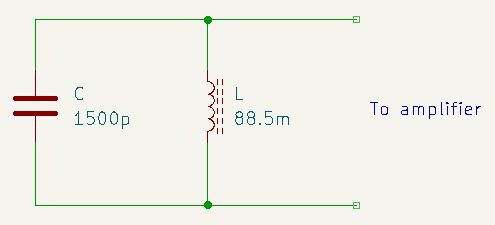 Figure 2
It now becomes a bit clearer that this circuit is a parallel resonance circuit where L is out antenna so it will pickup signals that will excite the resonator. We can calculate the frequency where the circuit is resonant with the formula $f = \frac{1}{2 \pi \sqrt{LC}}$
Entering the component values from the scematics we get $f = \frac{1}{2 \pi \sqrt{0.0885 * 1500e-12}} = 13813$ Hz.
If you look up any textbook about resonance, you will find that parallel circuits are considered band blocks and that you need a series resonance for maximum signal. So is this circuit wrong?
The text book examples usually focuses on the current, and for a series resonator the current is maximized at resonans, and for parallel resonance it is minimized. But the radio reception is not about current, it's about voltage. To get the maximum voltage we need the high impedance that the parallel resonance creates. This also means we can not load this circuit with anything other then a very high impedance or we will loose the voltage. The MOSFET amplifier makes sure to provide a hight impedance, as does the 4.7 MOhm resistor to earth.
In the textbooks you also see figures of the circuit being driven by some external source, this is not at all how it works here, quite the opposite in fact. The "source" in our case is the MOSFET, but it is not sourcing anything, it is sampling. The generation or energy comes from induction, that is, the magnetic part of the electromagnetic field that always surrounds us. This is also why we need a ferrite rod as opposed to a ferrite core. A core is closed and can not interact with external magnetic fields. A rod on the other hand is open and can easilly interact with an external magnetic field. The rod does have a blind spot though, the ends. If you point the end of the rod at a magnetic field source, the rod will not pickup much of a signal at all. So listening to a radio station we must point the side of the rod towards the radio station for the strongest induction. The field is very weak and hence the induced current is also very weak. That is why we need resonance to increase the amplitude as much as possible. It is the circuits Q factor that decides how hight the impedance get and therefore the voltage, so we aim for high Q. Unfortunately high Q also means lower band with, so we need to be able to adjust the capacitor and/or inductor if we want to look at other frequencies.