GeoDMS GUI - ObjectVision/GeoDMS GitHub Wiki
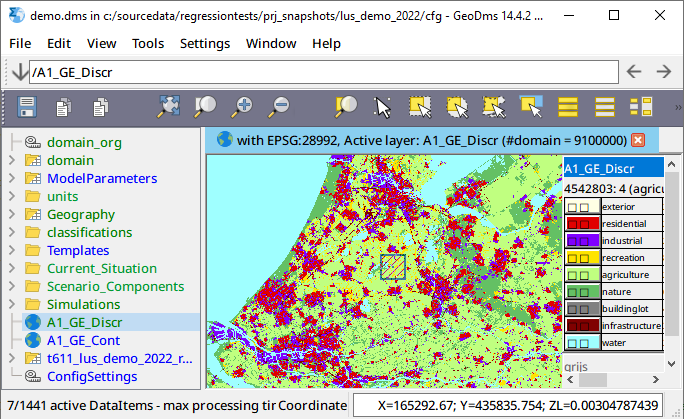
The GeoDMS GUI is used to visualise source data, calculation results and model logic. It presents both the model results and the steps needed to generate the results.
The GUI contains a set of viewers for maps, tables and graphs. Classifications and visualisation styles can partly be edited in the GUI, but will not be stored persistently (see the section How To Model for storing these settings persistently).
It also contains viewers for descriptive/meta information and process schemes to show the model logic.
software
The GUI is developed in C++, like the GeoDMS Engine, with the Qt library.
The GUI component is an executable called: GeoDmsGuiQt.exe. The component is part of the GeoDMS software to be installed from the releases section.
the standard prelude
The installation ships a configuration file of its own next to the executable: prelude.dms. It belongs to no project and holds the standard function definitions (sqr, abs, rescale, normalize, concat, MakeDefined, the multi-argument add/mul/and/or, the null-aware comparisons and some thirty more) that any configuration can call without configuring or including anything.
Opening a configuration adds the prelude to the loaded tree as a container prelude under the root item, hidden and endogenous: the [TreeView]] shows it only with Settings > [GUI options > Show hidden items activated, and it is never written back to the configuration files. It is the last scope a call head is looked up in, an implicit outermost namespace, so a function or template of your own with the same name is found first and simply shadows the prelude one. Tools > Check all function definitions type-checks the prelude definitions along with the configuration's own, which is why it reports many more definitions than the project contains.
sqr(x) is not an operator but a function definition of the prelude. The prelude takes the place of the rewrite rules in RewriteExpr.lsp, an engine data file next to the executable that substitutes one expression by another before anything is typed or looked up. Such a rule matches on syntax only: no argument type is checked, and its result type is whatever the substitution happens to produce; its head captures the name, so that an item of your own with that name is rewritten away before the configuration is consulted; and, being versioned with the executable, it applies to every model at once. A typed function definition has none of those properties: it is checked once at its own definition, user names shadow it by the normal scope rules, and it is readable as ordinary GeoDMS syntax rather than as Lisp patterns. The remaining rewrite rules are therefore replaced one by one, each by a prelude function whose body produces exactly the expression that the rule produces, so that the results of a configuration do not change.
how to use
See User Guide section GeoDMS GUI.