Project Proposal - JunS1/MCG GitHub Wiki
Effects of Deforestation Worldwide
Code Name: Deforest-MCG
Team Members: Molly R. Kappes, Jun Song, Zachary F. Shanshory, Drishti Vidyarthi
Affiliation: Info-201: Technical Foundations of Informatics The Information School University of Washington Autumn 2019
1.0 Introduction
1.1 Problem Situation Stakeholders: Organisms that are native to the forests (plants and animals), indigenous people that live nearby, loggers, miners, farmers/cattle ranchers, and the government (Bradford, 2018). Setting: Forests across 189 different countries (Bradford, 2018). Policy and Ethics: Deforestation is leading to other environmental issues such as climate change by increasing the amount of carbon dioxide in the atmosphere. Also, as more animals are forced out of their habitats, it is creating a larger risk for species extinction. There have been policies issued by the UN to address this issue, such as the Paris Agreement created to address climate change by focusing on greenhouse gas emissions (Heller, N., Stolle F., 2016).
1.2 What is the Problem? The problem our group is focusing on concerns deforestation throughout the world and the rate at which it has occurred over the past several decades. As deforestation destroys the lives of organisms and their surrounding ecosystems, it also makes the world more dangerous for humans. With forests and rainforests being logged/removed at alarming rates, it’s important for humans to understand the ecological and societal repercussions of their actions (Schwartz, 2014).
1.3 Why Does it Matter? Our planet thrives because of ecological factors such as biodiversity, and since such a large scale of wildlife lives within forest biomes, we need to make sure that their lives are being considered. We cannot continue to allow money and other economic factors cloud the fact that the world’s forests are a necessary part of our planet’s wellbeing, and they need protection (Schwartz, 2014).
1.4 How Will it be Addressed? We will address this problem by understanding how the rates of deforestation have been changing overtime and in which places deforestation has had the largest negative effects. We will create some interactive visualizations to show the importance of this data, and so that those viewing the project can easily understand the problem. Additionally, we will be using large data sets that have information on 189 of the world’s countries to reveal any trends based on region.
2.0 Research Questions
RQ #1: What effect does logging and anthropogenic causes have on forests worldwide annually? RQ #2: How have deforestation rates changed overtime and how effective are current measures taken to reduce deforestation?
3.0 Possible Data Sets
Data will be taken from https://www.gapminder.org/data/ under the Environment → Forestry tabs Data Set #1: Forest Coverage
- A data set containing the percentage of total land area that has been covered with forest during the given year. Each row represents a different country while the columns represent different years. The years span from 1990 - 2015.
Data Set #2: Wood Removal
- A data set containing the amount of wood removed (volume of round wood over bark) for production of goods and services. Similar to the first data set, each row represents a different country and the columns represent different years. The years span from 1990 - 2011.
Data Set #3: Primary Forest Area
- A data set containing the total area of forest land (in hectares) with native species, where there are no clearly visible indications of human activities and the ecological processes are not significantly disturbed. The rows are different countries while the columns are different years. The years span from 1990 - 2015.
4.0 Info Visualizations
 Figure 1: This map shows the percentage of forest coerage around the globe. Our group intends to replicate a similar interactive visualization for our project. (Source: The World Bank)
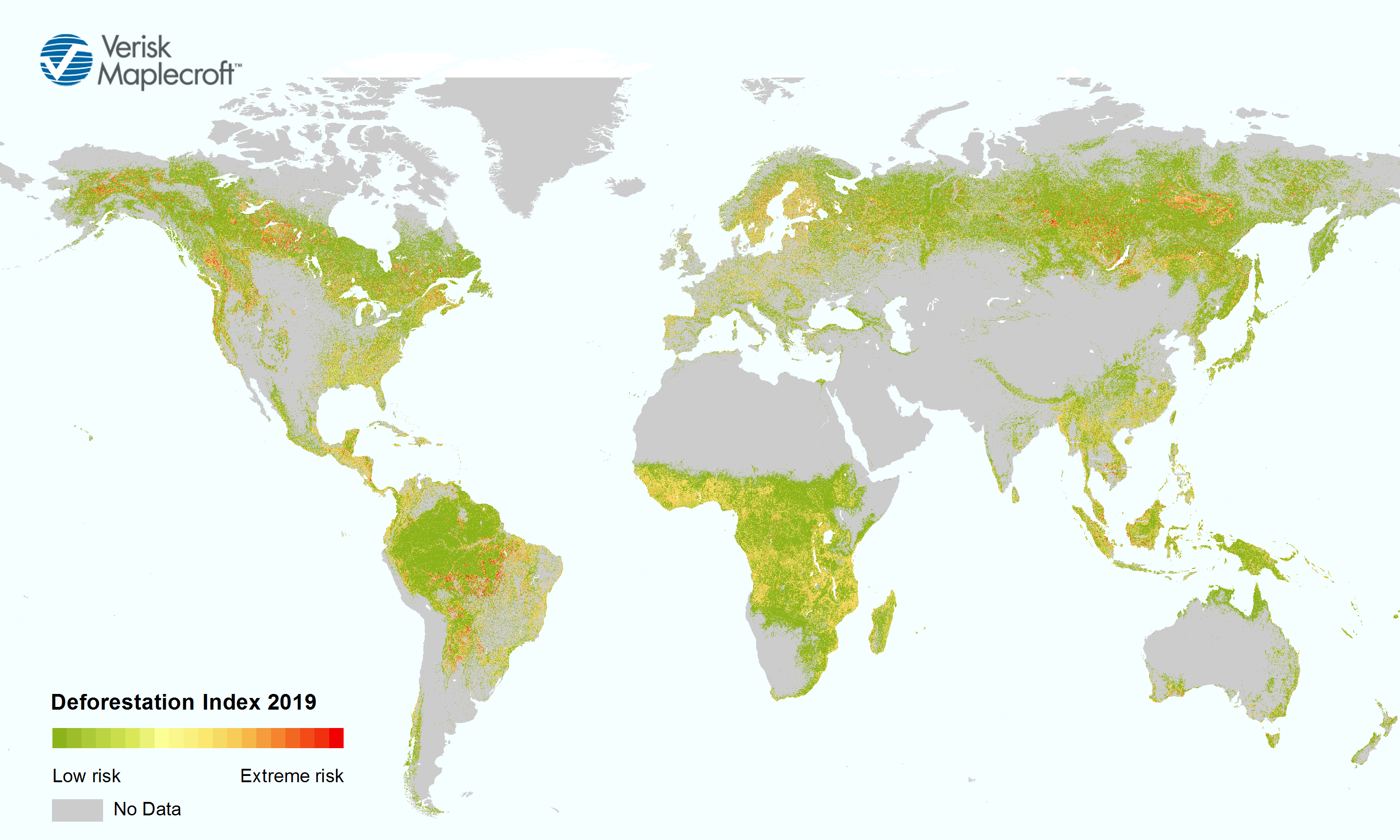 Figure 2: This map shows areas with risks of deforestation. The intensity of the risk is indicated by the color shown on the Deforestation Index Scale. Our group plans to create a similar visualization with our wood removal data set. (Source: Verisk Maplescroft)
5.0 Team Coordination
- Weekly Meetings: We will meet on Fridays from 4:30-6:00 every week and will schedule more meetings if necessary later during the quarter.
- Individual Goals
- Molly R. Kappes: To gain skills in data analysis using R and apply them to effectively gain insight on real world problems.
- Jun Song: To apply my knowledge of R to better communicate data sets to others.
- Zachary F. Shansory: To improve my skills for parsing through datasets and obtaining values such as means, standard deviations, and more. Learning how to process data into impressive visualizations.
- Drishti Vidyarthi: To learn how to analyze and understand data better using R. I also want to understand how studying these large sets of data can help us find solutions to larger scale problems.
- Communication Platform: We will be using a group text message chat to update each other on project changes, meetings, and anything else concerning the project. Our group will be meeting at least once a week to work on the project.
- Feedback/Communication Standards: We will do our best to divide the work and complete our assigned tasks in a timely manner. We will then look over each other’s work to make sure everything matches in our project and is running smoothly. We will provide one another with constructive criticism and help each other when needed. At our meetings we will delegate tasks, brainstorm ideas, and make plans for the following week.
6.0 Questions for Teaching Team
No questions at the moment.
7.0 References
- Figure 1 - The World Bank. “Forest Area (% of Land Area).” Actualitix World Data and Statistics, https://en.actualitix.com/country/wld/forest-area-by-country.php.
- Figure 2 - Verisk Maplecroft. "Deforestation Index 2019." https://www.maplecroft.com/risk-indices/deforestation-index/
- “Deforestation: Facts, Causes & Effects.” LiveScience, Purch, 4 Apr. 2018, www.livescience.com/27692-deforestation.html.
- Harris, Nancy, and Fred Stolle. “Forests Are in the Paris Agreement! Now What?” World Resources Institute, 26 Sept. 2018, www.wri.org/blog/2016/01/forests-are-paris-agreement-now-what.
- Schwartz, Jason. “6 Reasons Stopping Deforestation (Still) Matters.” Greenpeace USA, 16 Nov. 2015, www.greenpeace.org/usa/6-reasons-stopping-deforestation-still-matters/.
- “Data.” Gapminder, www.gapminder.org/data/.