Mathematical Strategies Used In Japanese Mathmatics - JessCreativeDev/Group-Wiki-Project-2 GitHub Wiki
Influences from Chinese Mathematics
In its earliest form, Japanese mathematics was rooted in Chinese mathematics from the 2nd century, primarily Zhoubi Suanjing (Translated as The Gnomon of the Zhou Dynasty) and Jiuzhang Suanshu (Translated as The Nine Chapters on the Mathematical Art). While the original authors are not known, they arrived in Japan thanks to Lui Hui's Stum Jing Shi Shu, which was meant to train Chinese bureaucrats (Ken’ichi, 2011a). This book combined Zhoubi Suanjing and Jiuzhang Suanshu with other mathematical books available at the time into a single comprehensive collection of what was known about mathematics in China (Ken’ichi, 2011a). These works were brought over to Japan thanks to Kibi no Makibi The following were the most notable contributions Hui' Stum Jing Shi Shu made to Japanese Mathematics (O’Connor & Robertson, 2003):
- Approximating Pi to 3.14
- Basic Arithmetic for whole numbers and fractions
- Finding the areas of triangles, rectangles, circles, trapeziums
- Proportions between fractions
- Square and Cube Roots
- Limits
- Finding the volumes of prisms, pyramids, tetrahedrons, wedges, cylinders and truncated cones
- A rule of double false position
- Basically, giving two answers to a formula and then computing an approximation based on those guesses
- Solving linear systems of equations
- The Pythagorean Theorem (Known in the book as the Gougu Rule)
- Solving Quadratic Equations with a Square-Root Algorithm
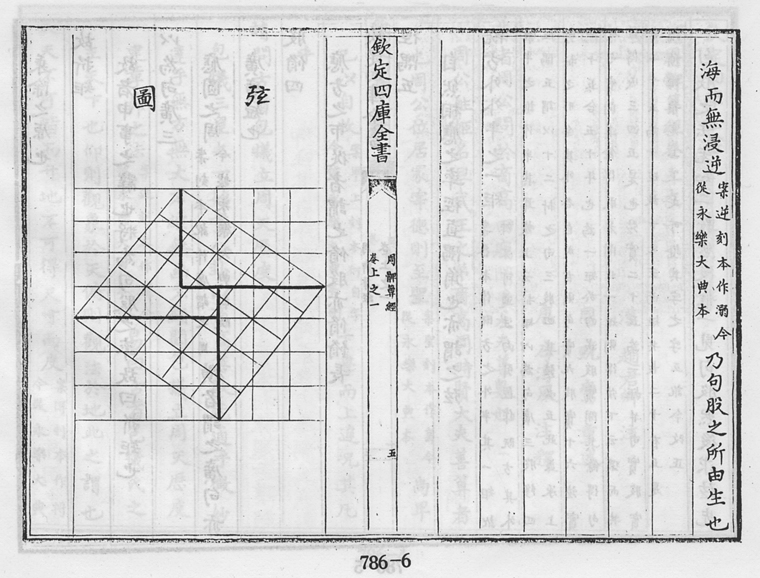
Figure 1. Pages Describing What Would Be The Pythagorean Theorem in Zhoubi Suanjing
However, while Liu Hui's book did lay the foundations of Japanese Mathematics, the field would not flourish until the Edo period. Between those periods, minor innovations were brought over from China, such as a solution to equations called Tian Yuan Shu, which would lay more ground for the mathematical boom of the 17th century (Ken’ichi, 2011a).
Jinkoki
In the centuries leading up to the Edo period, Yoshida Mitsuyoshi wrote a book named Jinkoki, which was an operation manual for a Soroban, the Japanese version of an abacus. While there were many versions published during its circulation, there were always three main volumes. The volumes described various problems one could solve with a Soroban, including such as calculations of areas of rice fields, problems related to the construction of rivers and banks, geometric progression, and the Josephus problem (Ken’ichi, 2011b). Because of its comprehensive applications, Shinpen Jinkoki (the most widely used edition of the book) was used throughout the Edo period and was even the inspiration for Seki Takakazu's work.
Seki Takakazu's Techniques
In the Edo period, Japan's field of mathematics began to explode with innovation as they realized that some aspects of China's mathematics needed to improve. The leader of this revolution was Seki Takakazu, a bureaucrat of the Tokugawa family in the Koshu Domain. While not much is known about his personal life, we know much more about his contributions to Japanese Mathematics. His most notable works include Hatsubi Sanpo, Katsuyo Sanpo, and Kaifukudai no Ho. Hatsubi Sampo was the only book he himself published, as the rest of the works attributed to him were published by his disciples after his death (Ken’ichi, 2011c). According to Sato Ken'ichi, Seki Takakazu's contributions were so great that "Seki's name had spread among Wasan scholars to such a degree that he was even sometimes referred to as 'Sansei'", with "san" meaning mathematics and "sei" meaning sage (Ken’ichi, 2011c). The following are some of his most notable contributions to the field of Japanese Mathematics:
- He invented a form of notational algebra called Wasan that helped him find the solution to higher-order numerical equations that had multiple unknown variables, expanding on Quin Jiushao's use of Tian Yuan Shu notation (Selin, 1997)
- Was also used to study parabolas, hyperbolas, and the spirals of Archimedes, which was later used to calculate a determinant of order 5 (Selin, 1997)
- Invented a notation called Boshoho, which simplified alphanumeric characters into a single expression (Ken’ichi, 2011c)
- Extended Chinese methods of solving numerical equations of higher order using the Horner-Ruffini method (Selin, 1997)
- Discovered the conditions for the existence of positive and negative roots of polynomials (Selin, 1997)
- The discovery of Bernoulli numbers a year before Bernoulli (Selin, 1997)
- Accurately calculated pi to 9 decimal places by applying extrapolation to a polygon with 2^17 sides (Selin, 1997)
- Calculated the volume of a sphere using an original integral method called Enri (Selin, 1997)
- Calculations on conic sections and on Archimedes spirals (Selin, 1997)
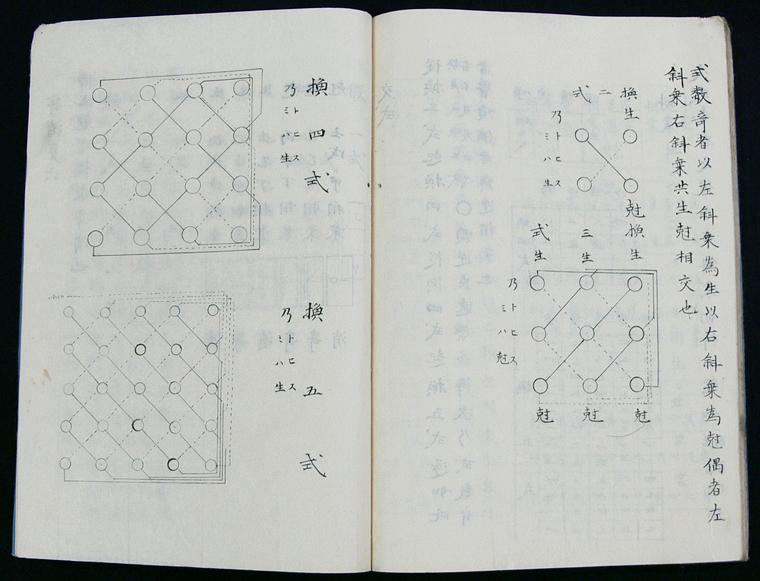
Figure 2. A section of Kaifuku Dai no Ho that describes how to calculate a determinant.
Later on, Takakazu's Disciples extended Takakazu's approximation of pi to thirty-one decimal places and used a formula equivalent to Taylor's expansion of the inverse of sin(x). Without knowing Western Mathematics, they had used this technique 15 years before Euler did (George Gheverghese Joseph, 1991/2011).
Works Cited
- George Gheverghese Joseph. (2011). The Crest of the Peacock: Non-European Roots of Mathematics (3rd ed.). Princeton University Press. (Original work published 1991)
- Ken’ichi, S. (2011a). Influences from Chinese Mathematics. Japanese Mathematics in the Edo Period. https://www.ndl.go.jp/math/e/s1/c1.html
- Ken’ichi, S. (2011b). Jinkoki. Japanese Mathematics in the Edo Period. https://www.ndl.go.jp/math/e/s2/1.html
- Ken’ichi, S. (2011c). Seki Takakazu. Japanese Mathematics in the Edo Period. https://www.ndl.go.jp/math/e/s1/2.html
- Ken’ichi, S. (2011d). Seki Takakazu & the Seki School. Japanese Mathematics in the Edo Period. https://www.ndl.go.jp/math/e/s2/2.html
- O’Connor, J. J., & Robertson, E. F. (2003, December). Nine Chapters on the Mathematical Art. Maths History; MacTutor. https://mathshistory.st-andrews.ac.uk/HistTopics/Nine_chapters/
- Selin, H. (1997). Encyclopaedia of the history of science, technology, and medicine in non-western cultures. Kluwer Academic.