Entity Framework (edmx with DB first approach) - ITsvetkoFF/Kv-013 GitHub Wiki
Entity Framework
Entity Framework (EF) is an object-relational mapper that enables .NET developers to work with relational data using domain-specific objects. It eliminates the need for most of the data-access code that developers usually need to write.
Entity Framework Architecture
The following figure shows the overall architecture of the Entity Framework. Let us now look at the components of the architecture individually:

EDM (Entity Data Model): EDM consists of three main parts - Conceptual model, Mapping and Storage model.
Conceptual Model: The conceptual model contains the model classes and their relationships. This will be independent from your database table design.
Storage Model: Storage model is the database design model which includes tables, views, stored procedures, and their relationships and keys.
Mapping: Mapping consists of information about how the conceptual model is mapped to the storage model.
LINQ to Entities: LINQ to Entities is a query language used to write queries against the object model. It returns entities, which are defined in the conceptual model. You can use your LINQ skills here.
Entity SQL: Entity SQL is another query language just like LINQ to Entities. However, it is a little more difficult than L2E and the developer will have to learn it separately.
Object Service: Object service is a main entry point for accessing data from the database and to return it back. Object service is responsible for materialization, which is the process of converting data returned from an entity client data provider (next layer) to an entity object structure.
Entity Client Data Provider: The main responsibility of this layer is to convert L2E or Entity SQL queries into a SQL query which is understood by the underlying database. It communicates with the ADO.Net data provider which in turn sends or retrieves data from the database.
ADO.Net Data Provider: This layer communicates with the database using standard ADO.Net.
Database First
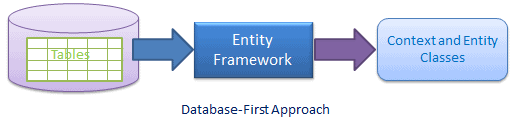
We have seen this approach in Create Entity Data Model where we created the EDM, context and entity classes from an existing database. So, when you generate EDMX from an existing database then it is a Database First approach.
.edmx File Overview
An .edmx file is an XML file that defines a conceptual model, a storage model, and the mapping between these models. An .edmx file also contains information that is used by the ADO.NET Entity Data Model Designer (Entity Designer) to render a model graphically.
