FAQ - IMN/api-docs GitHub Wiki
Do you have a process chart?
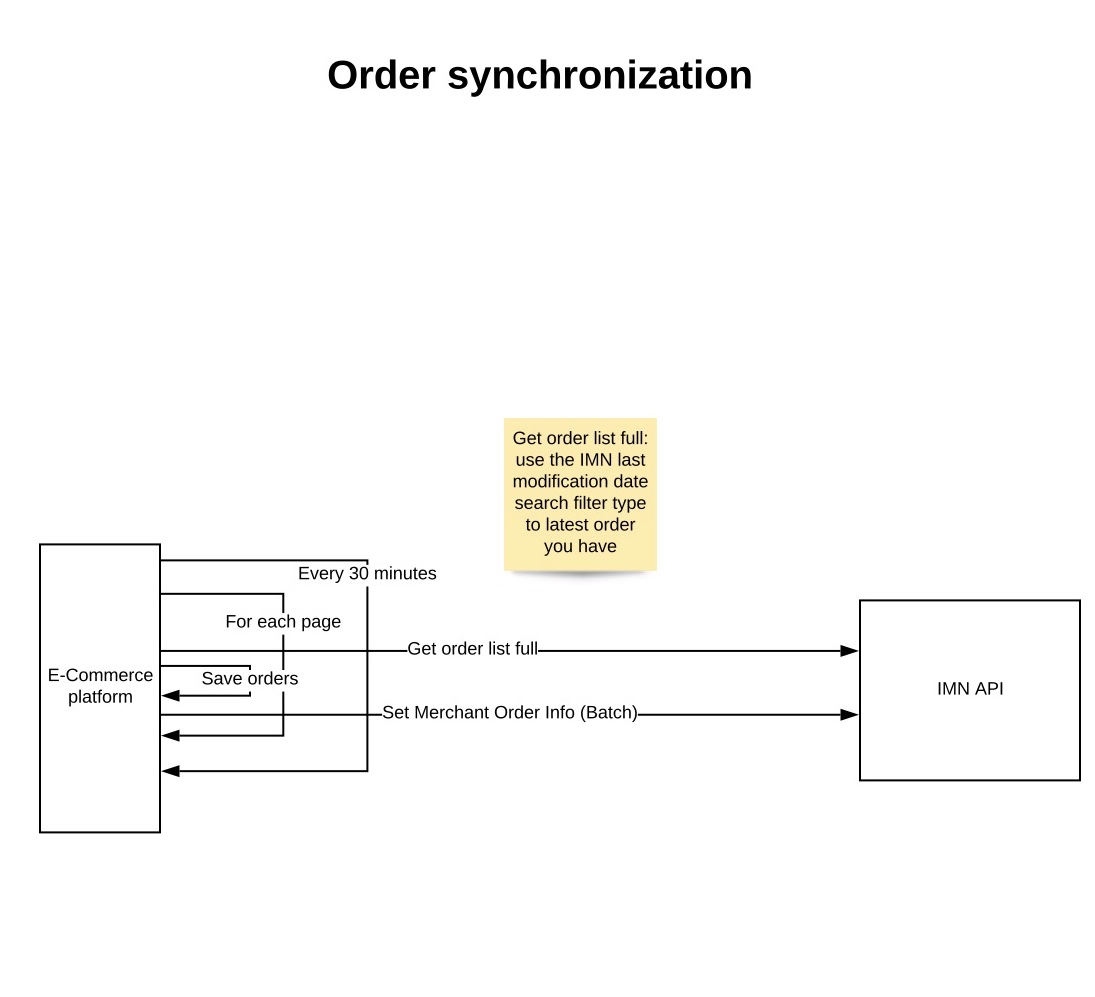
It would be great to get a process chart on the standard order processing using the web service. When we know the standard process, I think its easier to understand when to send requests and in which order we have to send the request to the web service.
Answer: Good question, we are currently working on it! Please see the order synchronization process that we recommend you to implement:
Authentication: is there an example how the authentification process works? There are 2 calls to request and reset the token, but it's not clear when these calls are needed.
Answer: the get token is used on go.imn.io to allow you to get copy/paste the token you have to use to connect to our API from an application that you have developed. The reset operation allows you to change your API token if you need it for security reasons for example.
Is there a limited lifespan for the token? Do we have to reset the token regularly?
Answer: The API token has no lifespan limitation. It depends on your security in place in your organization. We give you the operation to reset your API Token, after that it's up to you to reset it why you need to.
CorrelationID: where can we get this ID from? Its not clear how to use this ID when we make the first request to the web service.
Answer: The correlation id it's simply a Guid that is used to identify a group of operations related to the same intent. You can generate a Guid from your application if an operation requires it. Every coding language has his implementation that respect the same algorithm.
Merchant Code and Marketplace Code: can the merchant get these codes also from the IMN frontend? And do we have to create the merchant account by using the web service “Create the merchant account using the merchant code”?
Answer: The merchant account process is generally handled by https://go.imn.io registration process. Once it's done you don't need to use it anymore. Because you have your merchant code you have to indicate it in the path of every API operations. You can get the marketplace code list with the following API operation: https://api.imn.io/merchant/lov/v1/ActiveMarketplace
Order Items: There are only calls to process the whole order (for example cancel, refund and ship the order), is it also possible to manage each order item separately?
How do we manage partial cancellation or partial shipment?
Answser: For now, the partial operation on orders have not been implemented. For that use case, you will have to handle it manually using the back office provided by the target marketplace. Please inform your home marketplace about this feature request and we will prioritize this subject.
Call “Declare the abortion of the order change request”: can you please provide a use case for this call?
Until which order status can the order still be canceled by the customer?
Answer: This operation has been developed to allow you to abort an order change request operation. It does not cancel the order but the order change request operation
Call “Delete the order”: can you please provide a use case for this call?
Answer: IMN is GDPR compliant. For that, the delete order and delete merchant operations have been implemented and made accessible to the merchant
Call “Refuse Order” and “Cancel Order”: what is the difference of these calls and in which use case should we prefer one of them?
Answer: "Refuse order" must be used when the IMN order status is "New", otherwise you have to call "Cancel order". These operations are computed for you on every order depending on the IMN order status in the transitionLinks property. 
Call “Complete the publication of the merchant offers”: does this call stop all offers? Where do we get the parameter correlationId from?
Answer: This operation has been developed as a draft to allow you to push your offers inside IMN. The complete operation must be combined with the start one to inform IMN system that you have finish to push all your offer changes. Thanks to that information, we will be able to make reporting in the future. For now, do not use this operation. The Start/Complete operations will not make any change on your offers. The correlation id is a Guid. You can generate a Guid from your application if an operation requires it. Every coding language has his implementation that respect the same algorithm.
Call “Set an Order's merchant information”: What do you need this information for? Why is this information important and in which case should we update it?
Answer: This operation is useful for you in fact because you will be able to flag which orders have been synchronized with your e-commerce software. You will be able to search orders using this identifier if you want.