Throwable Weapons Impacts and Runic Bombs 1.12.2 - Herbertofury/Advent-of-Ascension GitHub Wiki
Home · Weapon reference library · Shared firing and inventory warnings
Historical throwable weapons: payment, impacts and Runic Bombs
Minecraft 1.12.2 / AoA 3.3.6. Seven direct throwable registrations, their constructors, self-ammunition methods, 67 behavior-method records and two Grenade recipes are checked. These are static references, not measured damage, explosion radius or runtime certification.
Prepare and throw
- These items inherit the historical BaseGun use path. Read its hand, attack-strength and payment checks rather than treating a throw as a completely separate input system.
- Each selected item method asks the shared inventory helper for 1 + Greed level copies of itself, then creates its projectile. Preserve the split-stack accounting warning.
- The base constructor sets max damage to 0 and stack size to 64. The selected enchantability method returns false. Greed handling in code does not prove ordinary enchanting can put Greed on these items; modified stacks or other mods are separate cases.
- Do not assume a Chakram or Vulkram returns to inventory just because of its name. Stack consumption is checked; a returning-item mechanic is not established by this review.
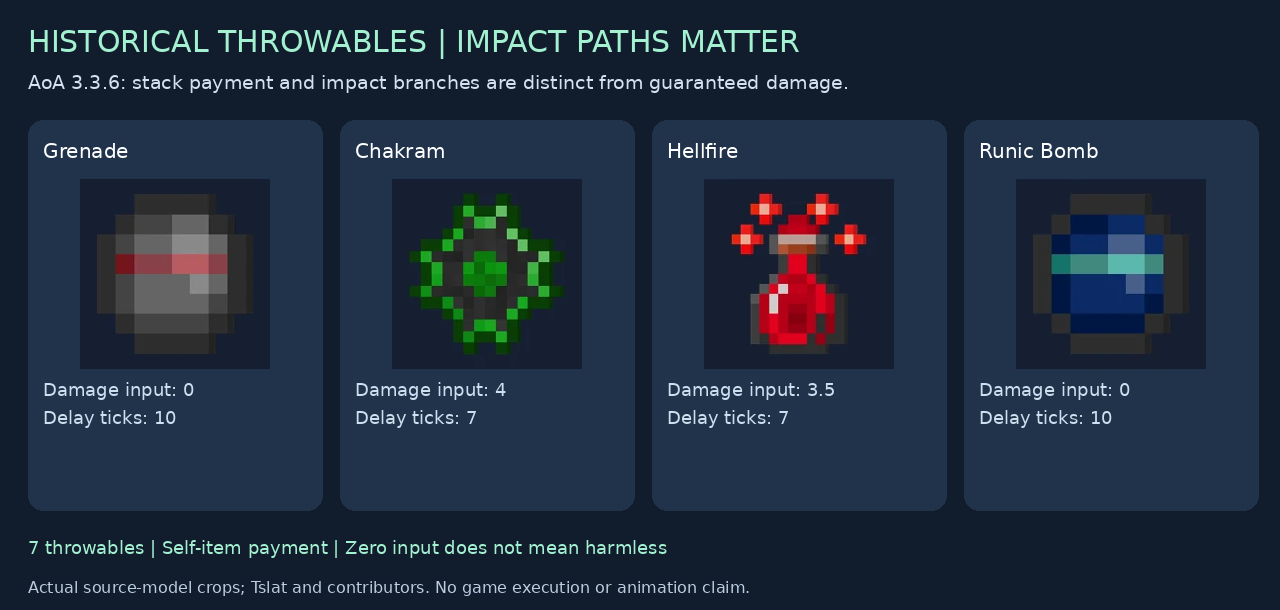
- Grenade and Runic Bomb have zero ordinary damage inputs. Their explosion paths make “zero means harmless” an incorrect interpretation.
Craft Grenades
Both released recipes are shapeless:
| Ingredients | Output | Illustrated recipe |
|---|---|---|
| Gunpowder + Scrap Metal + Iron Ingot | 3 Grenades | Ordinary recipe |
| Unstable Gunpowder + Scrap Metal + Iron Ingot | 10 Grenades | Unstable recipe |
These are the two matching direct-output recipe definitions found in the checked archive for this seven-item set. Missing direct recipe matches for the other items do not establish that they are unobtainable; inspect their same-release drop and acquisition references.
All seven entries
| Item and portrait | Ordinary damage input | Delay input · ticks | Selected effect or behavior |
|---|---|---|---|
| Grenade | 0 | 10 | Explosion helper uses default strength field 1.5; gravity getter approximately 0.075. |
| Slice Star | 4.5 | 7 | Ordinary ranged damage; projectile gravity getter approximately 0.05. |
| Chakram | 4 | 7 | Weapon-bound successful ranged-damage path requests Poison for 60 ticks, amplifier 1 (level II). |
| Goo Ball | 3.5 | 7 | Weapon-bound successful ranged-damage path requests Slowness for 60 ticks, amplifier 1 (level II), and plays its impact sound. |
| Vulkram | 3 | 7 | Weapon-bound successful ranged-damage path requests healing of 1 health point through the living/injured-recipient helper. |
| Hellfire | 3.5 | 7 | Common impact effect searches nearby EntityMob targets, attempts secondary projectiles and requests 10 seconds of fire. |
| Runic Bomb | 0 | 10 | Explosion strength field 1.5; nearby hostile-mob slow request and Runic Golem shield handling described below. |
Read the impact branch before combining effects
The selected BaseBullet collision handler runs on the server. For a new entity target, it chooses one of two damage routes:
- If a weapon reference exists, call the weapon's
doImpactDamage. - Otherwise, call the projectile's
doEntityImpact.
It then calls the projectile's common doImpactEffect. These are not interchangeable methods. For example, the weapon-bound Vulkram item path requests healing, while its weaponless projectile method only makes a direct thrown-damage call. Do not promise the same extra effects under every projectile state.
For Grenade and Runic Bomb, both the weaponless entity-impact method and the common impact method contain an explosion-helper call. Consequently, the selected weaponless branch can reach two helper invocations. This is a branch-specific restoration test target, not a claim of double final damage in a running game. The ordinary weapon-bound path is different. How a projectile becomes weaponless, persistence, spawn cancellation and mod hooks need separate runtime checks.
Runic Bomb: slow and shield handling
The common Runic Bomb impact method calls the explosion helper, then queries EntityMob instances in its bounding box expanded by 3. It requests Slowness with 30 ticks and amplifier 100, using ambient true and particles false. The unusually high amplifier is the released input; do not silently replace it with amplifier 1.
For each matching nearby Runic Golem whose shield flag is active, that common path calls deactivateShield. The weaponless entity-impact method has its own nearby slow loop and a direct-target Runic Golem shield check before the common handler follows. Preserve that distinction during restoration.
The expanded box is not a spherical radius, and the code request does not guarantee potion acceptance, successful explosion damage or compatibility with every protection mod.
Hellfire: targets and the advancement hook
The common Hellfire impact method searches EntityMob targets in a box expanded by 7, attempts one secondary Hellfire projectile for each, and calls fire with 10 seconds on each target. It counts matching targets while doing this. With at least 20 counted targets and a server-player shooter, it calls the overworld/heckfire advancement helper for criterion 20_target_hellfire.
This is a target-count condition, not proof of 20 kills, 20 successful projectile spawns or a fixed damage total. Treat the secondary projectile's eventual effects separately.
Terrain and collision safety
The player-fired explosion helper consults destructiveWeaponPhysics before passing its destruction flag to the world explosion call; its fiery flag is false in this selected path. Other exploder/entity branches can use doStrongerMobGriefing. A strength field of 1.5 is not a promise of a 1.5-block radius or a universally harmless explosion.
BaseBullet's block-collision path can also destroy certain low-hardness blocks under destructiveWeaponPhysics before deciding whether to continue to the common impact method. Test away from valuable builds. A disabled terrain-destruction flag does not by itself mean entities cannot be hurt.
Restoration checks
- Check exact self-item payment, empty/partial stacks and the shared inventory-helper edge cases.
- Keep weapon-bound, weaponless, block-impact and repeated-pierce paths separate in tests.
- Chakram and Goo Ball cast a successful ranged-damage target to EntityLivingBase in their item hooks. The shared helper has accepted nonliving/multipart routes, so validate the target type before the potion cast; do not call this an in-game crash reproduction.
- Test Runic Golem shields, the high-amplifier slow request, and both explosion branches.
- Test Hellfire's counted targets separately from successful spawns, fire acceptance and advancement completion.
- Preserve stack-based throwing in optional remodels rather than silently adding magazines or mandatory reloads.
Exact released evidence and recipe definitions · Source-model crop provenance.