Survey Analisis - Hamster339/Piping-Tool-Java GitHub Wiki
Introduction
Overall the survey can be considered successful, as it attracted 39 respondents from the target demographic of pipers, and the results can be used to inform the design of the software. The raw results can be seen on the survey results wiki page: https://github.com/Hamster339/Piping_Tune_List/wiki/Survey-Results
Demographical questions (Q1-Q4)
The survey software used (Survey monkey) does not allow exporting the data in the free version. As manually recording all responses would be very time-consuming, it is not possible to make full use of this data by seeing the difference in opinion between different groups, past cherry-picking a few examples.
However it does show that the results represent a wide portion of the piping community, and so are expected to be reliable and informative.
Current habits section
Q5. Which of the following best describes how you currently keep track of/organize your repertoire of tunes?
The results show that the majority of people use physically filed sheet music to organise their repertoire. Other significant responses are no organisation and recorded on a pc/app.
This shows that any design should be focused on attracting people who use physically filed sheet music if the software is to be successful, although support should also be available for people who store their sheet music on a pc.
Q6. Which platform would you be most likely to use a tool like this on?
The results show that people much prefer to use a mobile app to use the software, closely followed by a website, with relatively few people choosing a pc program.
This shows the string preference respondents have to the app and website, which could be interpreted as desiring portability, as that is what these two platforms share. An interesting idea suggested in the "other" option is both a pc program and an app that syncs together.
Design section
Q7. Please select the four program features that you would find most useful/essential.
All the features were picked by respondents relatively equally, showing most of the proposed ideas have potential.
The "Being able to hide rarely used tunes/list from view without deleting them," option was significantly less popular than the others, showing it is less important to people. It should be noted that the low popularity may have been caused by the option being poorly worded/ people not fully understanding the feature, so the idea should not be completely abandoned without further consideration
Three options had significantly higher popularity than the rest, showing that they are more important. These, in descending order, are:
- Being able to link and view the sheet music for each tune from the program
- Being able to organize tunes into separate lists
- Being able to share groups of tunes with others
Overall, the reliability of this question is damaged by poor understanding. it is hard for a participant to fully grasp what these features mean without seeing examples, and only a brief description to go off. Therefore although the results can be used to inform whether the features should be included in the design, they are not particularly useful when deciding on the priority of features during development.
Q8. Which of the following two possible designs do you find the most appealing?
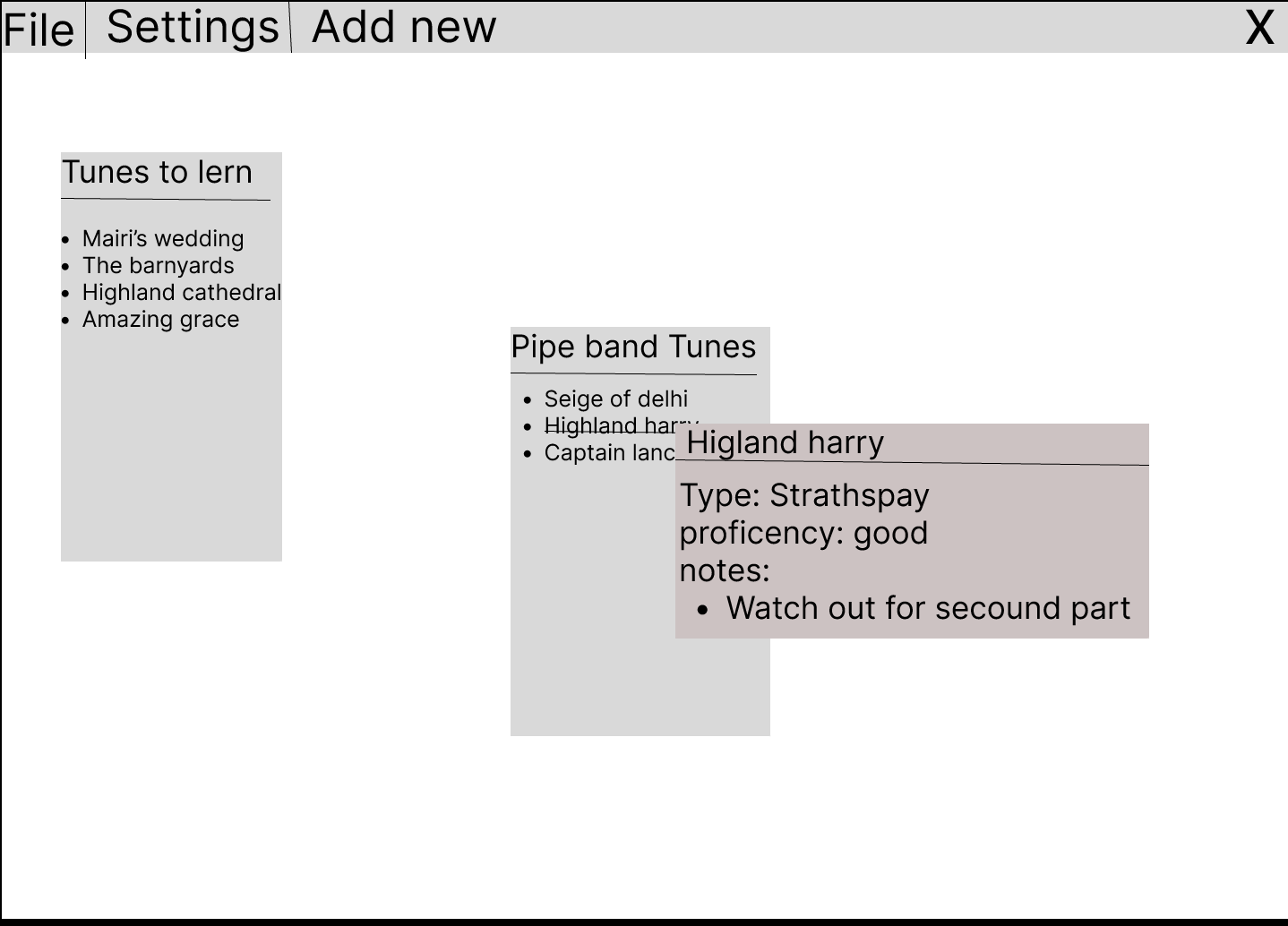
The designs in question are shown below:
Design A:
Design B:
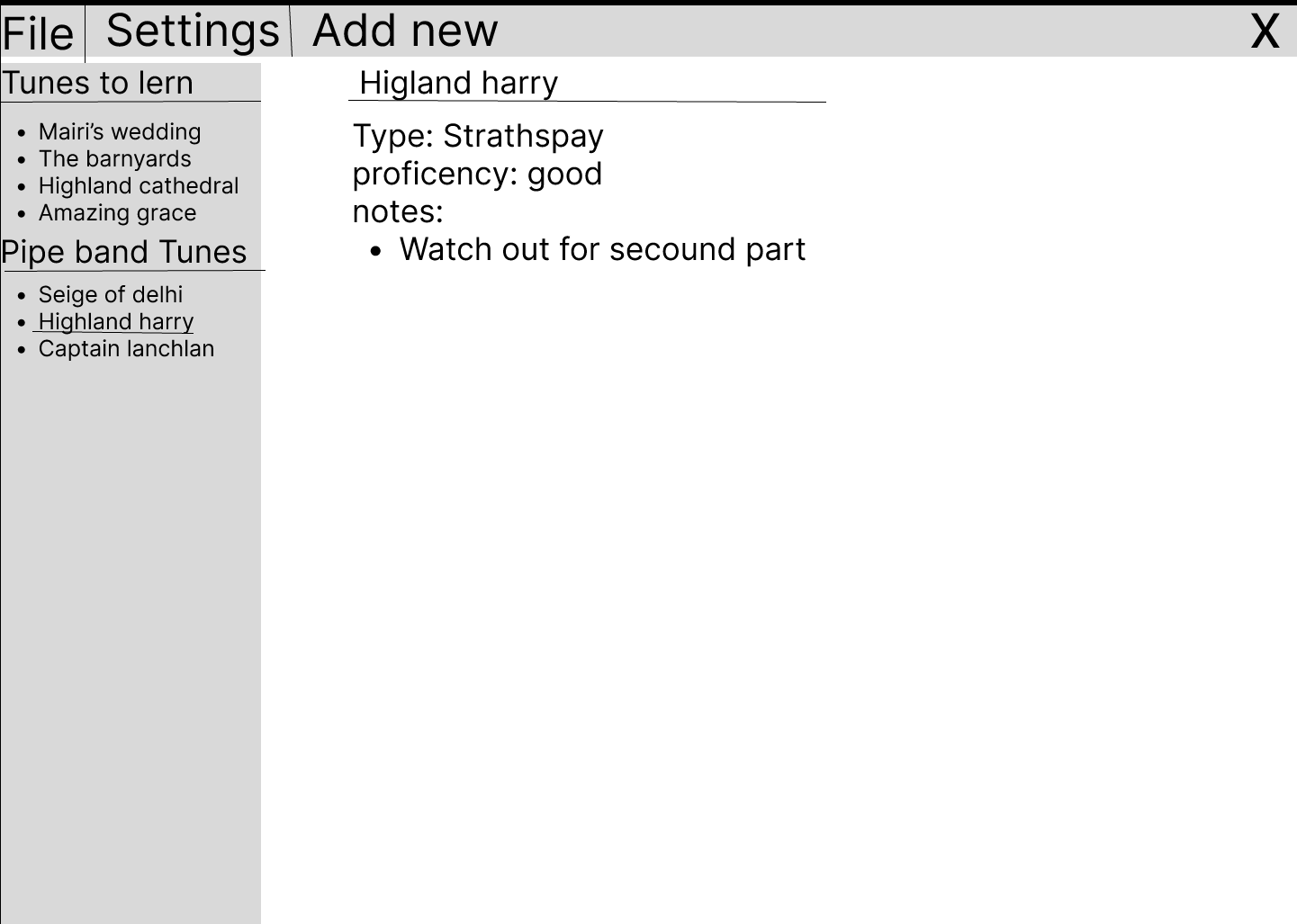
The results show an overwhelming preference for design A, so the rest of the design should expand on this idea.
Q9 If a program like this existed, how likely would you be to try it?
The majority of respondents fell into the somewhat likely to the very likely range. This shows that there is a demand for the software and that people are likely to use it.
Q10 Other comments/ideas
A few interesting ideas were suggested that should be considered for possible features
-
"Built-in metronome for set lists with saved tempos and breaks"
-
"I think being able to store the scores would be very helpful so that you have one database for all your tunes."
-
"As Pipe Major of a (mediocre) band I wonder whether you could expand this concept to keep track of different pipers ability by tune, and come up with a set list based on which pipers are attending an event"
Integrating the functionality of metronome apps such as pipers metronome is a very interesting, yet advanced idea. Enabling the software to support plug-ins may be a way of realistically achieving this
Storing the sheet music within the program itself is an idea that has occurred multiple times in this survey. Although due to the fact that most people still use physical sheet music, as found in Q5, the software must support both people who want to store music in the software and people who want to store it outside.
The idea of expanding the software to support pipe band coordination is very interesting and has lots of potential. However, features in this direction differ significantly from the original purpose of this project. Because of this, this idea may be better suited to later development, or perhaps a separate version of the program designed specifically to cater to pipe band coordination, which could be built of this software.
Conclusions
Overall, the feedback from the survey provides some useful insights. It shows that the piping community approves of the idea and many agree that it would be useful, confirming that there is a problem that this software could fix.
The results show clearly that design A is preferred showing that the suggested features are all (except one) useful, provides some notion of which are more important to people and shows a preference for platforms enabling mobility.
With these results, it should be possible to design software that is functionally useful to the pipers.
Evaluation
Overall the survey was successful. However, it has two weak points that should be addressed in any feature surveys.
First, not being able to export the data to be properly analysed significantly reserved the usefulness of the data, and conclusions could not be drawn on the differing opinions of different sections of the piping community. In future, a different survey platform should be used that allows this.
Additionally, the Question asking respondents to pick from different features was executed poorly. This is because is was difficult for respondents to fully understand the features when presented with nothing but a sort description. In future, a different question structure or method should be used to determine the usefulness and priority of features.