2. GATHERING PERTINENT INFORMATION - H-division-2022-2023-even/Repo06 GitHub Wiki
ELECTRO MECHANICAL CLOCK
NEED STATEMENT
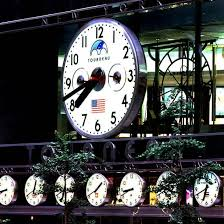
A clock company in hubli needs analog clocks which shows minimum two countries timings and provides alarm sound after every hour or predefines intervals.
Introduction
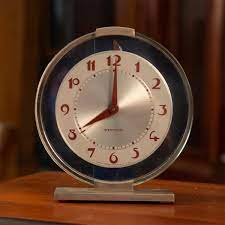
*Electromechanical clocks have a traditional mechanical [movement], which keeps time with an oscillating [pendulum] or [balance wheel] powered through a [gear train] by a [mainspring], but use electricity to rewind the mainspring with an [electric motor] or [electromagnet]. This mechanism is found mostly in antique clocks.
- Electric remontoire clocks have gear trains turned by a small spring or weighted lever, called a [remontoire], which was wound up more frequently by an electric motor or electromagnet. This mechanism was more accurate than a mainspring, because the frequent winding averaged out variations in the clock's rate caused by the varying force of the spring as it unwound. It was used in precision pendulum clocks, and in automotive clocks until the 1970s. *Electromagnetic clocks keep time with a pendulum or balance wheel, but the pulses to keep it going are not provided by a mechanical movement and [escapement] linkage, but by [magnetic force] from an electromagnet ([solenoid]. This was the mechanism used in the first electric clocks, and is found in antique electric pendulum clocks. It is also found in a few modern decorative mantel and desk clocks.
- Tuning Fork clocks keep time by counting the oscillations of a calibrated tuning fork with a specific frequency. These were only made in battery-powered form. Battery-powered clocks have been made using the schemes above with the obvious exception of a synchronous movement. All battery-powered clocks have been largely replaced by the lower cost quartz movement.
- Synchronous clocks rely on the 50 or 60 Hz utility frequency of the [AC] [electric power grid] as a timing source, by driving the clock gears with a [synchronous motor]. They essentially count cycles of the power supply. While the actual frequency may vary with loading on the grid, the total number of cycles per 24 hours is maintained rigorously constant, so that these clocks can keep time accurately for long periods, barring [power cuts]; over months they are more accurate than a typical quartz clock. This was the most common type of clock from the 1930s but has now been mostly replaced by quartz clocks.
Importance
- Time is important for scheduling and planning. Mechanical clocks help us keep track of time and adhere to schedules.
- They have been a reliable timekeeping tool for centuries.
- They are still used in scientific and industrial applications today.
- Mechanical clocks are valued for their aesthetic appeal and historical significance.
Principle
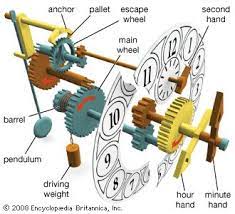
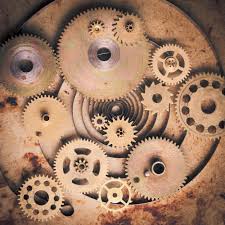
There are many structural forms of mechanical clocks, but their working principles are basically the same. Clocks and watches are mainly composed of the prime mover system, transmission system, escapement governor, pointer system and winding needle system. The mechanical clock uses a clockwork as the motive force of the driving system, and drives the escapement governor to work through a transmission system composed of a set of gears, and the escapement governor in turn controls the speed of the transmission system. The drive train drives the pointer mechanism while pushing the escapement governor. The speed of the drive train is controlled by the escapement governor, so the pointer can indicate the time on the dial according to a certain rule.
Composition
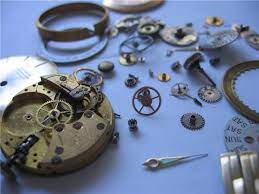
Mechanical clocks can be made of a variety of materials including brass, steel, aluminum, wood, glass, enamel, and ceramics. Common clock components such as gears, levers, and pendulums are typically made of brass or other metals due to their strength and durability. Clock cases can be made of wood and clock faces can be made of glass or enamel, which can be decorated with intricate designs. The choice of materials used in a mechanical clock depends on the clock's design, function, and intended use.
| Sl. No. | Components used | mechanism identified | links referred | image |
|---|---|---|---|---|
| 1 | Main Spring | a coiled spring that stores energy to power the clock. | https://www.youtube.com/watch?v=zQIr8ynBPqY | 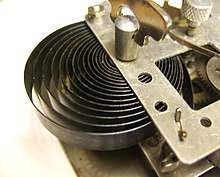 |
| 2 | Escapement | a mechanism that regulates the release of energy from the main spring to the timekeeping mechanism. | https://roymech.org/Useful_Tables/Cams_Springs/Escapements.html https://www.princeton.edu/~timeteam/graham.html | 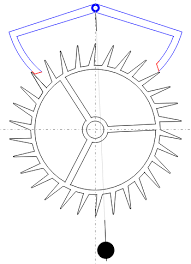 |
| 3 | Balance Wheel | a weighted wheel that oscillates back and forth to regulate the clock's timekeeping. | https://en.wikipedia.org/wiki/Balance_wheel | 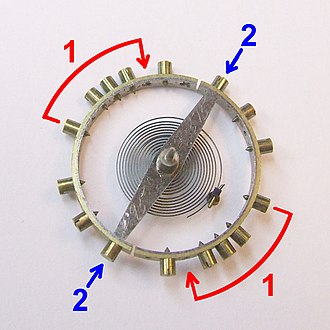 |
| 4 | Pallet Fork | a device that interacts with the escape wheel to regulate the clock's timekeeping. | https://www.luxuo.com/homepage-slider/examining-the-escape-wheel-and-pallet-fork.html | 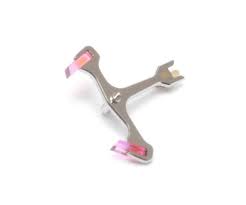 |
| 5 | Pendulum | a weight suspended from a fixed point that swings back and forth to regulate the clock's timekeeping. | https://www.scienceabc.com/innovation/pendulum-clock-works-escapement-ticking-sound-falling-weight.html https://www.explainthatstuff.com/how-pendulum-clocks-work.html | 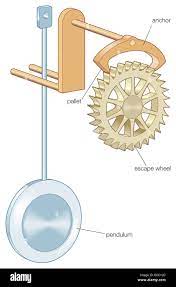 |
| 6 | Dial | the clock's face that displays the time. | https://en.wikipedia.org/wiki/Clock_face | 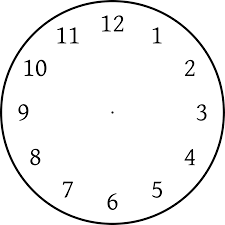 |
| 7 | Minute Hand | a hand that indicates the minutes on the clock's face. | https://www.splashlearn.com/math-vocabulary/time/minute-hand | 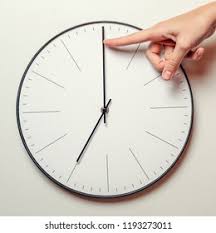 |
| 8 | Cannon Pinion | a gear that connects the hour, minute, and second hands to the clock's timekeeping mechanism. | https://www.youtube.com/watch?v=Aa1IoYkLqfc | 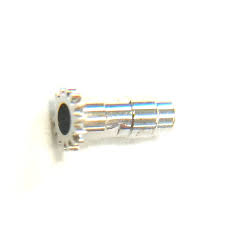 |
| 9 | Click | a device that prevents the main spring from unwinding too quickly. | https://electronics.howstuffworks.com/gadgets/clocks-watches/inside-clock.htm |  |
| 10 | Barrel | a cylinder that holds the main spring. | https://en.wikipedia.org/wiki/Barrel_(horology) | 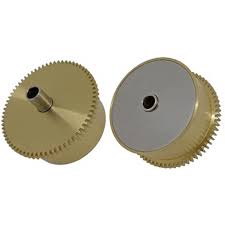 |
| 11 | Hour Hand | a hand that indicates the hours on the clock's face. | https://www.splashlearn.com/math-vocabulary/time/hour-hand | 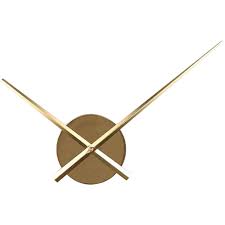 |