CreatingOutfits - Fzzr/endless-sky GitHub Wiki
The thumbnail graphics for all the outfits in the game are created using two free, open source programs: Blender for creating the 3D models, and GIMP for post-processing the rendered images to look more grungy and less artificial. (Another open source program, Inkscape, is used for the vector graphics in the user interface.) You can download the original Blender and GIMP files for any of the graphics here.
Any outfit model you create in Blender should use the camera and lighting settings from this template. That will ensure that your new thumbnails do not look out of place next to the existing ones. The template is set up with sunlight coming from a certain angle and with the image rendered in an orthographic projection along the XYZ diagonal, so that a cube in your model will line up exactly with the cubical grid used as a backdrop for the outfits.
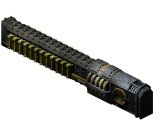
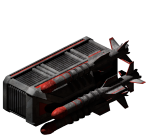
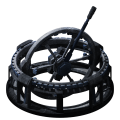
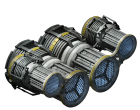
The outfitter view divides outfits into difference categories: "Guns," "Turrets," etc. As another way of ensuring a consistent look, most outfits in a given section point in a certain direction:
- Guns: top left.
- Turrets: top left, and angled slightly up in the Z axis.
- Missiles: bottom left.
- Anti-missiles: top right.
- Engines: bottom right.
In a few cases, it's ambiguous which direction something should point in. For example, the Flamethrower is aligned with the guns even though it is shown in the "Secondary Weapons" section with all the missiles.
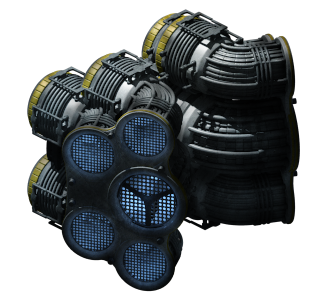
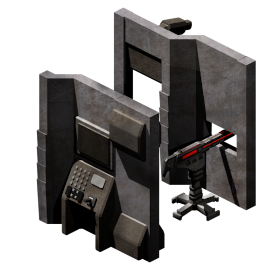
As with ships, it is often easier to add texture and color variation to the outfit images in GIMP rather than trying to texture map all the surfaces in Blender. And, also as with the ship graphics, be sure that your GIMP file is at least high enough resolution to create an "@2x" high resolution version.
Outfits work by modifying the attributes of your ship. Many of the attributes are in units of heat or energy per frame; a frame is 1/60th of a second. All attributes stack. For example, if you install two shield generators, your shield regeneration doubles.
Most attributes are given as a single number, but there are a few "special" attributes:
-
category: which outfitter category to show this outfit in. The category must be one of the following if it is to be purchaseable:- "Guns"
- "Turrets"
- "Secondary Weapons"
- "Ammunition"
- "Systems"
- "Power"
- "Engines"
- "Hand to Hand"
- "Special"
-
"flare sprite": for thrusters, the image that is drawn at each of the engine hardpoints when the thruster is firing. -
"flare sound": for thrusters, the sound that is played when the thruster is firing. -
"afterburner effect": the effect that is created for every frame that the afterburner is firing. Afterburner effects can last for multiple frames, leaving a trail behind the ship. -
thumbnail: the thumbnail image to use for the outfit in the outfitter. Outfit thumbnails should be no larger than 360x360 for the @2x sprite and 180x180 for the normal-resolution sprite. -
description: a paragraph of text to show in the outfitter. To define multiple paragraphs, you can add more than one "description" line.
The other attributes include:
-
"active cooling": amount of cooling this outfit provides when heat is at 100%, at which level it will consume its entire"cooling energy". When heat is at 0%, no energy is consumed and no active cooling is provided. -
"afterburner energy": energy consumed by the afterburner in one frame. -
"afterburner fuel": fuel consumed by the afterburner in one frame. -
"afterburner heat": heat produced by the afterburner in one frame. -
"afterburner thrust": thrust produced by the afterburner in one frame. -
"atmosphere scan": not usable by the player, but indicates that the AI will treat this ship as if it wants to fly past planets to "scan" them. -
atrocity: if you are caught carrying this outfit, the government that scanned you turns hostile. If the scan happens when you are landed on planet, you are immediately captured and imprisoned for life. -
bunks: additional crew / passenger space. -
"capture attack": this outfit can be wielded by a crew member and adds this amount to their base strength of 1 when attacking another ship's crew. Each crew member can only wield one such outfit, and they will make use of the best outfits available in each combat round. -
"capture defense": this outfit can be wielded by a crew member and adds this amount to their base strength of 2 when defending against boarders. -
"cargo scan": sets the distance from which this outfit can be used to scan a ship's cargo. -
"cargo scan power": the cargo scanning range is 100 times the square root of this number. This means you need four scanners to get twice the range of one scanner. (v. 0.9.5) -
"cargo scan speed": The time it takes to complete a cargo scan is one second divided by the square root of this number. This means you need four scanners to get twice the speed of one scanner. (v. 0.9.5) -
"cargo space": amount of cargo space that this outfit adds (if positive) or removes (if negative) from your ship. -
cloak: how quickly a cloaking device cloaks or uncloaks. When cloaking, this amount is added to your cloaking each frame until you reach 1, at which point your ship is fully cloaked. The opposite happens when uncloaking. -
"cloaking energy": how much energy it takes each frame to maintain cloaking. -
"cloaking fuel": how much fuel it takes each frame to maintain cloaking. -
"cloaking heat": how much heat is generated per frame to maintain cloaking. -
cooling: heat subtracted from your ship by this outfit, per frame. -
"cooling energy": energy consumed by"active cooling"when heat is at 100%. -
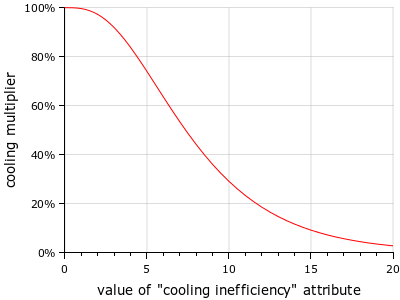
"cooling inefficiency": the higher this attribute is, the less effective your cooling systems are. Both active cooling and regular cooling will be multiplied by2 + 2 / (1 + exp(i / -2)) - 4 / (1 + exp(i / -4)), which forms the S-curve shown below. (v. 0.9.7)
-
cost: cost of this outfit, in credits. -
"disruption resistance": an extra amount of shield disruption that this ship "bleeds off" every frame. (v. 0.9.9) -
drag: please do not create outfits that reduce a ship's drag, because if the drag becomes zero or negative it can cause problems. -
"energy capacity": how much energy your ship can store. -
"energy consumption": energy consumed each frame. -
"energy generation": energy generated each frame. If you do not have any energy capacity, this energy does not carry over from frame to frame. -
"engine capacity": if negative, how much engine space an outfit uses. Engine space and weapon space are an important part of giving different ship models different strengths and weaknesses, so I recommend against creating outfits that give you extra engine capacity, or engines that do not use up engine space. -
"fuel capacity": the amount of fuel storage provided by this outfit. -
"fuel consumption": the amount of fuel consumed per frame (v. 0.9.9).
On any frame in which the ship can supply its total"fuel consumption", it will also evaluate the following attributes:-
"fuel energy": energy produced per frame from consumed fuel. (v. 0.9.9) -
"fuel heat": heat produced per frame from consumed fuel. (v. 0.9.9)
-
-
"fuel generation": fuel produced per frame. (v. 0.9.9) -
"gun ports": any weapon that fires forward (i.e. is not a turret) must have a value of -1 for this attribute. That is how the game recognizes that it is a gun. Outfits cannot provide more gun ports, because each gun must be tied to a specific hardpoint in the ship model. The only way to get more hardpoints is to upgrade to a bigger ship. -
"heat dissipation": outfits should not modify this. If you want an outfit to help cool off a ship, use the "cooling" attribute instead. -
"heat generation": how much heat this outfit generates every turn, regardless of whether it is working at full capacity or not. For example, a power generator will create its full amount of heat even if your batteries are fully charged and the energy it creates is just being thrown away. -
hull: I recommend against providing outfits that give ships additional hull strength, because that could create balancing issues. But if you want to do it, this is the attribute to modify. -
"hull energy": the amount of energy that hull repair draws when recharging at the full rate. (Prior to v. 0.9.0, hull repair also draws an additional amount of energy equal to"hull repair rate".) -
"hull fuel": the amount of fuel that hull repair consumes when recharging at the full rate. (v. 0.9.9) -
"hull heat"is the amount of heat that hull repair creates when recharging at the full rate. (v. 0.9.1) -
"hull repair rate": the number of hull points regenerated per frame. It takes 1 energy to repair 1 unit of hull. -
hyperdrive: set this to 1 if an outfit is a hyperdrive. -
illegal: the fine, in credits, for being caught using this outfit. -
"ion resistance": an extra amount of ionization that this ship "bleeds off" every frame. (v. 0.9.9) -
inscrutable: if a ship has a nonzero value for this attribute, you cannot scan its outfits. (v. 0.9.7) -
installable: if set to a value below zero, this outfit cannot be installed. (As of v. 0.9.0, the trading panel will display these outfits as "harvested materials," and the outfitter will display a helpful message if you try to install them.) -
"jump drive": set this to 1 if this outfit is a jump drive. -
"jump speed": how slow your ship must be moving in order to jump. -
"jump fuel": how much fuel the ship consumes when using this outfit to jump. The default is 100 for hyperdrives, 150 for scram drives, and 200 for jump drives. (v. 0.9.7) -
map: number of hyperlinked star systems that are mapped by this outfit. -
mass: how much your ship's mass should change by when this outfit is installed. -
"outfit scan": sets the distance from which this outfit can be used to scan a ship's outfits. -
"outfit scan power": the outfit scanning range is 100 times the square root of this number. This means you need four scanners to get twice the range of one scanner. (v. 0.9.5) -
"outfit scan speed": The time it takes to complete an outfit scan is one second divided by the square root of this number. This means you need four scanners to get twice the speed of one scanner. (v. 0.9.5) -
"outfit space": if negative, how much generic outfit space (as opposed to weapon or engine space) this outfit takes up. -
"radar jamming": how much resistance this ship has to radar tracking. The missile's chance of maintaining its lock is proportional to is"radar tracking"value divided by (1 + the ship's"radar jamming"). (v. 0.9.1) -
ramscoop: fuel regeneration. Each frame, your ship gains fuel proportional to .03 * √("ramscoop"). The square root is so that each additional ramscoop will have less effect than the previous one; otherwise, ramscoops would make weapons and afterburners that run on fuel way too powerful. As of v. 0.9.0, ramscoops are more effective near the system center: the fuel gain is multiplied by.2 + 1.8 / (distance to center / 1000 + 1). Also starting in 0.9.0, when very close to the star even ships with no ramscoop recharge a tiny amount of fuel. Beginning with v. 0.9.9, the amount of fuel gained varies based on the type of star(s) in the system. -
"required crew": turrets (and maybe other high-end outfits) can increase your crew requirements. It might also make sense to provide outfits, such as an android crew replacement, that reduce crew requirements (in exchange for energy consumption or some other penalty). -
"reverse thrust": if your ship has reverse thrusters installed, the "back" button will apply reverse thrust instead of turning your ship. -
"reverse thrusting energy": energy cost per frame of reverse thrusting. -
"reverse thrusting heat": heat produced per frame of reverse thrusting. -
"scan interference": your odds of a scan of your ship discovering anything illegal you have are equal to1 / (1 + scan interference). For example, if "scan interference" is 3 you evade 75% of scans. -
"scram drive": a scram drive can engage as long as your ship is moving in the direction of the target system. This value is how much your ship can be drifting relative to that vector and still be allowed to jump. -
"self destruct": a value between 0 and 1, representing the probability that a ship will self destruct when you try to plunder it or, after succeeding in boarding it without it self destructing, try to capture it. That is, the probability of successfully boarding a ship with self destruct is(1 - "self destruct"), and the probability of both boarding and capturing it is(1 - "self destruct")^2. (v. 0.9.0) -
"shield energy": the amount of energy your shield generator draws when recharging at the full rate. (Prior to v. 0.9.0, shield recharge also draws an additional amount of energy equal to"shield generation".) -
"shield fuel": the amount of fuel that shield regeneration consumes when recharging at the full rate. (v. 0.9.9) -
"shield generation": the number of shield points regenerated per frame. It takes 1 energy to regenerate 1 unit of shields, so if your shields are recharging your ship has less energy available for other things. -
"shield heat"is the amount of heat that shield generation creates when recharging at the full rate. (v. 0.9.1) -
shields: I recommend against providing outfits that give ships additional shield strength, because that could create balancing issues. But if you want to do it, this is the attribute to modify. -
"slowing resistance": an extra amount of slowing damage that this ship "bleeds off" every frame. (v. 0.9.9) -
"solar collection": the amount of energy that this outfit provides when your ship is 1250 pixels from the system center. As you come closer, you will harvest up to twice as much power; farther away, and the energy generation slowly tapers off to 1/5 of this value. (v. 0.9.0) Beginning with v. 0.9.9, the amount of solar energy collected varies based on the star(s) in the current system. -
thrust: your ship's acceleration per frame equals thrust / mass. -
"thrusting energy": energy cost per frame of thrusting. -
"thrusting heat": heat generated each frame when thrusting. -
turn: your ship's turn rate is (turn / mass) degrees per frame. -
"turning energy": energy cost per frame of turning. -
"turning heat": heat generated each frame when turning. -
"turret mounts": as with"gun ports", any outfit that fits in a turret hardpoint must have a value of -1 for this. -
unplunderable: if set to 1, this outfit cannot be plundered (for example, for hand to hand weapons and outfit expansions). (v. 0.9.0) -
"weapon capacity": set this to a negative value (generally, the same value as"outfit space") for any outfit that is a weapon. Limited weapon space is one of the ways that ship models are differentiated from each other.
An outfit that provides a weapon contains an extra set of attributes inside a weapon tag. These attributes must be placed in the weapon block to have any effect. If you have multiple weapon blocks in one outfit, they are just merged together; that doesn't make an outfit provide two different weapons. Some weapon attributes have special formats:
-
sprite: the path to the sprite, relative to the "images" folder, and not including the frame number or extension (e.g. "projectile/flamethrower", not "images/projectile/flamethrower+0.png"). The sprite field can also have "child" elements, which include:-
"frame rate": <fps#>: animation frames per second. -
"frame time": game ticks per animation frame. A game tick is 1/60th of a second. This is an alternative way of specifying frame rate; if you specify both the last specification will be used. -
delay: number of animation frames to delay in between loops of the animation. For example, a four-frame animation with a delay of 4 and a frame rate of 8 FPS will play the animation for half a second, then pause for half a second, then repeat. -
"start frame" <frame#>: which frame to start the animation at. -
"random start frame": start the animation at a random frame (e.g. so if you fire a bunch of projectiles, they won't all be pulsing through the animation in unison with each other). -
"no repeat": the animation stops after it has played through once. (If "rewind" is also specified, it will play forward, then play backward, then stop.) -
rewind: the animation plays forward, then reverses, rather than looping back to the beginning when it reaches the end.
-
-
"hardpoint sprite": the sprite (which ought to be very tiny) to draw on top of the hardpoint where this weapon is installed, to show what direction the weapon is pointing in. Generally, this should only be used for turrets, because the gun hardpoints on many ships are already designed to look like guns. This sprite definition can use any of the same animation values as the ship sprite. (v. 0.9.7) -
"hardpoint offset": The distance, in screen pixels, between the center of the hardpoint sprite and the point that projectiles should emerge from. Assuming the gun barrel is at the very top of the sprite, this will be 25% of the sprite's height in pixels. The weapon's range is effectively increased by this amount. (v. 0.9.7)- For versions v. 0.9.9 and later, can be an x, y coordinate relative to the center of the hardpoint sprite, e.g.
"hardpoint offset" -1.2 8.7, in order to accommodate asymmetric hardpoint sprites. Axes orientation is the standard Cartesian, where+xis "rightward" and+yis "upward."
- For versions v. 0.9.9 and later, can be an x, y coordinate relative to the center of the hardpoint sprite, e.g.
-
sound: a path to a sound, relative to the "sounds" folder, and not including the extension or the loop specifier (e.g. "laser", not "sounds/laser~.wav"). The sound file must be a mono (not stereo) WAV file with 16-bit, 44100 Hz encoding. -
ammo: if specified, an outfit which provides ammunition for this weapon. Each time it is fired, one outfit of that type is removed from your ship. -
icon: for secondary weapons, the icon that will be shown along with this weapon's ammunition count. -
Effect objects are created for various stages of a projectile's existence:
-
"fire effect": created when this weapon fires (such as a smoke cloud from a missile launch). You can specify a number to create more than one instance of the effect. -
"live effect": created while the projectile is in flight. You can specify the number of times this effect will be created, on average, during the projectile's lifetime. (v. 0.9.0) -
"hit effect": created when this projectile hits something. You can specify a number to create more than one instance of the effect. You can also specify multiple different hit effects. -
"die effect": created if this projectile reaches the end of its lifetime without hitting anything.
-
-
submunition: if the projectile reaches its end of life, create a new set of projectiles based on the given weapon outfit. The damage and hit force associated with a parent projectile is the sum of both its own damage and hit force attributes, and those of its submunitions. -
stream: this tag (just the word by itself, no value following it) makes a weapon fire in "stream" mode (multiple copies of this weapon take turns firing) even if it is susceptible to anti-missile. (v. 0.9.0) -
cluster: this tag (just the word by itself, no value following it) makes a weapon fire in "cluster" mode (all copies of the weapon fire at the same time, rather than alternating). (v. 0.9.0) -
safe: this tag (just the word by itself, no value following it) will prevent this projectile from accidentally damaging any allied ships, even via explosions. If a ship is explicitly targeted, or an enemy, it will still be damaged. (v. 0.9.9) -
phasing: this tag (just the word by itself, no value following it) enables the projectile to only hit the intended target (instead of perhaps colliding with a closer ship in the line of fire). If a ship has no target, then a phasing projectile will hit any hostile ship in the line of fire. Asteroids - even if targeted - are not hit by phasing weaponry. (v. 0.9.9) -
"no damage scaling": this tag (just by itself, no value following it) prevents any damage scaling associated with blast damage from being applied: the nominal damage and hit force values are dealt at the center of the blast and at the very edges. (v. 0.9.9)
Ordinary weapon attributes (those that take a number as an argument) include:
-
lifetime: how long the projectile lasts before it "dies." -
"random lifetime": a random number of frames up to this amount will be added to each projectile's lifetime. (v. 0.9.2) -
velocity: initial velocity of the projectile, relative to whatever fired it (which may be a ship or a "parent" projectile of which this is a submunition). -
"random velocity": a random amount up to this number will be added to the projectile's initial velocity. (v. 0.9.0) -
acceleration: projectile's acceleration, per frame. If this is nonzero, it should be coupled with a nonzerodragto limit the projectile's total speed. -
drag: percent loss of speed per frame. For example, a projectile with an acceleration of 1 and a drag of .1 will have a maximum speed (acceleration / drag) of 10. -
turn: If the projectile is homing, how much it is allowed to turn each frame to seek its target. Otherwise, it will always turn by this amount, which can be used to create spinning projectiles or other effects. -
inaccuracy: the maximum error, in degrees, in a projectile's firing angle. Inaccuracy limits a weapon's effectiveness at long range but can also make it look a bit more "natural" and unpredictable. -
"firing energy": the energy cost to fire this weapon. -
"firing force": the thrust generated by firing this weapon. -
"firing fuel": fuel consumed when this weapon fires. -
"firing heat": heat produced when this weapon fires. -
reload: how many frames this weapon takes to reload: 1 means it fires every turn (e.g. most beam weapons), and 60 means it fires once per second. -
"burst count": how many projectiles this weapon can fire in a row at a higher reload rate ("burst reload"). The total time in between bursts will be"burst count"*reload. (v. 0.9.0) -
"burst reload": how fast the weapon reloads when firing projectiles in a burst. This value must be less than the fullreloadvalue. (v. 0.9.0) -
homing: How good this weapon is at seeking its target:- 0: no homing.
- 1: projectile loses its homing ability if no longer facing toward the target.
- 2: dumb homing (always try to turn to point toward the target).
- 3: stop thrusting if you miss the target, in order to turn back towards it in a tighter loop.
- 4: rather than moving directly towards the target, calculate an interception point based on the projectile's speed and the target's current speed.
- Tracking attributes (as of v. 0.9.1) control how well a projectile seeks targets, and accept values from 0 to 1:
-
"infrared tracking": how well this projectile tracks targets based on their heat. That is, hot targets will be easier to track. -
"optical tracking": how well this projectile tracks objects based on their size. That is, large targets will be easier to track. -
"radar tracking": how well this projectile tracks targets using radar (which ships can resist if they have"radar jamming"). -
tracking: a form of tracking that is constant, regardless of the ship's size, heat, or radar jamming ability.
-
-
"missile strength": how hard a projectile is for an anti-missile to destroy. If this is 0, the projectile cannot be destroyed by anti-missile. -
anti-missile: weapon's ability to shoot down missiles. The anti-missile succeeds if a random integer less than this value is greater than a random integer less than the missile's strength. -
"split range": when the projectile is within this range of its target, it will split into its submunitions. (If no target was selected when the weapon was fired, this does nothing.) -
"trigger radius": how close a projectile must be to a hostile target to trigger its explosion. This only makes sense to use with weapons with a"blast radius"at least as big as their"trigger radius". -
"blast radius": all ships (friendly and hostile) within this radius are damaged if this projectile explodes. Note: anything with a blast radius will show up on radar, like missiles do. Beginning in v. 0.9.9, any weapon with a blast radius is subject to damage scaling - objects closer to the center of the blast take more damage. Weapons with a trigger radius have their nominal damage boosted a small amount to compensate.

-
"hit force": how much thrust is applied to a ship when this projectile strikes it. If this is negative, the ship is pulled towards the projectile. Hit force associated with blast damage is also scaled. -
piercing: a value between 0 and 1, controlling what fraction of the weapon's damage "pierces" through shields and does direct damage to the hull instead. When the target's shields are still up, shield damage will be(1 - piercing) * "shield damage"and hull damage will bepiercing * "hull damage". - There are several damage types, and a weapon may have more than one type. Generally, most weapons include shield and hull damage, as a ship's shields mitigate incoming damage, and without hull damage, the target cannot be eliminated.
-
"shield damage": how much damage a projectile does to shields. -
"hull damage": how much damage a projectile does to hull. -
"heat damage": how much heat is added to a target when struck by this projectile. If the target's shields are up, heat damage is cut in half. -
"fuel damage": how much fuel is removed from a target when struck by this projectile. If the target's shields are up, fuel damage is cut in half. (v. 0.9.9) -
"ion damage": how much ionization is added to a target when struck by this projectile. If the target's shields are up, ionization is cut in half. Ionization drains energy and dissipates at a rate of 1% per frame. For example, a ship that takes 10 ion damage will lose 10 energy that frame, 9.9 energy the next frame, 9.801 energy the next, and so on until ionization tapers off to 0. That means the total energy loss from that one ion impact will be 10 + 99% * 10 + 99% * 99% * 10 + ... = 10 / 1% = 1000 energy. -
"disruption damage": works like ionization, adding a "shield disruption" effect that fades by 1% each frame. When disrupted, your shields only block1 / (1 + .01 * disruption)of weapon damage, and the rest pierces through your shields and damages your hull. For example, if a ship has accumulated 10 disruption, about 9% of damage will leak through to the hull. (v. 0.9.0) -
"slowing damage": accumulates like ion and disruption damage, and dissipates at 1% per frame. Multiplies your ship's turn rate and acceleration by1 / (1 + .05 * slowness). (v. 0.9.0)
-
In order for anyone to buy your new outfit, it must be added to one of the "outfitter" objects. For example, if you are writing a plugin you could include this in one of your data files:
outfitter "Syndicate Advanced"
    "My Fancy New Outfit"
    "My Other Fine Outfit"
Any outfits you list will be appended to the outfits currently in the list you named. So, the above example would make two new outfits available on all planets that have the "Syndicate Advanced" outfits.
In Escape Velocity, the classic series of games that Endless Sky is patterned after, there were some outfits that were so powerful compared to their size that there was no reason not to install them if you could afford it: for example, outfits that took no space and improved your acceleration and turn rate, or very small outfits that boosted your shields considerably. As a result, those games needed to put a limit on how many of each outfit could be installed.
In Endless Sky, I'm attempting to have the balancing happen naturally, without putting fixed limits on how many copies of an outfit you can install. For example, that means that more powerful outfits tend to be larger or much more expensive (or both), and may have other side effects like generating a lot of heat or requiring more energy than other alternatives.
However, it is still quite possible to do things like buying a bulk freighter and installing 30 outfits expansions, which then lets you pack in an absurd number of shield generators. If outfits were provided that could increase your shield or hull strength, or your weapon or engine capacity, it would be very hard to keep the game balanced - a Bactrian freighter would have the capacity to be far more powerful than any warship, just because of its large cargo space.
So, when creating new outfits, it's important to keep in mind not just what you think would be cool, but whether your new outfits will be unbalanced. If you're creating a weapon that is so good that no ship will want to install anything else, that's a balance problem.