JLP and FujiNet on the Intellivision - FujiNetWIFI/fujinet-firmware GitHub Wiki
This page mirrors docs/JLP-and-FujiNet.md in fujinet-intv-jlp-test, which also has the test ROM and a printable booklet.
JLP and FujiNet both live in the same 8K-word window of the
Intellivision's memory map, $8000-$9FFF, and on a FujiNet cartridge they
are literally the same RAM. This page explains how they share it, what a
game has to do to use both, and what the
test ROM in this repository checks.
JLP is Joe Zbiciak's "Jean-Luc Project" cartridge board. Many
homebrew carts implement it (LTO Flash among them), and IntyBASIC's
--jlp switch targets it. It gives a game:
- 8,000 words of 16-bit RAM at
$8040-$9F7F; - hardware multiply and divide (
$9F80-$9F8F), a CRC-16 unit ($9FFC,$9FFD) and a random number register ($9FFE); - save-game flash: rows of 96 words in 8-row sectors, copied to and from
JLP RAM by commands at
$8023-$802F.
FujiNet on the Intellivision is a cartridge with two processors: an
RP2040 or RP2350 that answers the console's bus (firmware descended from
PiRTO II and Minty) and an ESP32-S3 running the FujiNet firmware, joined by
USB. The console talks to FujiNet through a mailbox: 832 words of cart
RAM at $9C00-$9F3F holding a header (sequence numbers, device, command,
parameters, status), a 256-byte transmit buffer and a 512-byte receive
buffer. The console fills in a request and bumps SEQ; the cart carries it
to the ESP32, writes the reply and sets ACKSEQ last.
The cart emulates JLP too, so JLP games run on it. Its RAM for the JLP window and the mailbox is one array.
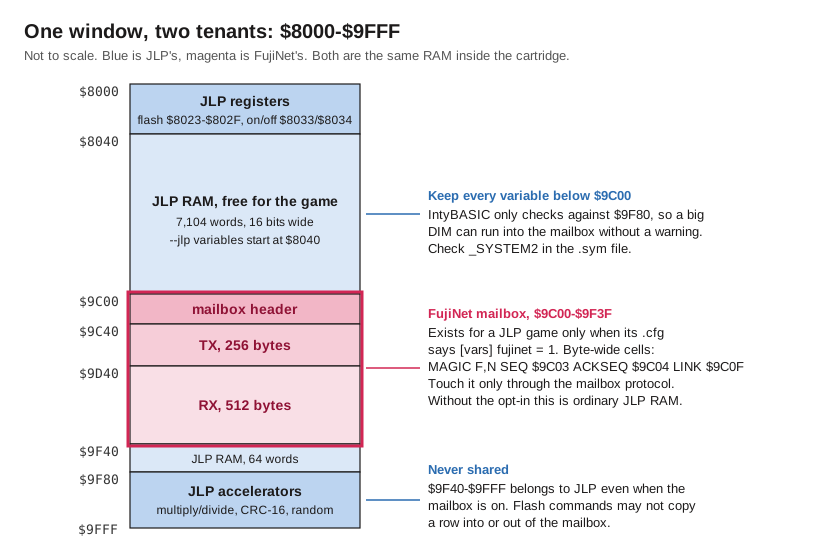
| Range | Owner | Notes |
|---|---|---|
$8000-$803F |
JLP | Registers: flash first/last row $8023/$8024, flash address/row $8025/$8026, commands $802D-$802F, accelerators on/off $8033/$8034
|
$8040-$9BFF |
JLP | 7,104 words of RAM for the game |
$9C00-$9F3F |
FujiNet | The mailbox, when the game opts in; otherwise plain JLP RAM |
$9F40-$9F7F |
JLP | 64 more words of RAM |
$9F80-$9FFF |
JLP | Multiply/divide, CRC-16, random numbers |
A FujiNet-aware JLP game therefore gives up 832 words of JLP RAM. Nothing else changes: the accelerators, the flash commands and the RAM on either side of the mailbox behave as they would on any JLP board.
When FujiNet boots a game (CONFIG's MOUNT_IMAGE), the ESP32 pushes the ROM
and its .cfg to the cart, and the cart maps the game from the .cfg.
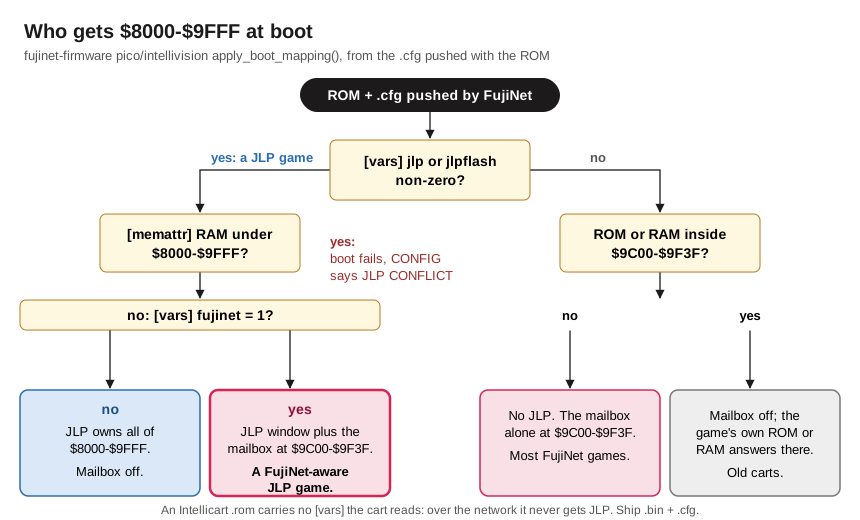
The game's .cfg
|
$8000-$9FFF |
Mailbox |
|---|---|---|
no jlp or jlpflash
|
game ROM/RAM, if any | at $9C00-$9F3F, unless the game's own memory covers it |
jlp or jlpflash, no fujinet
|
JLP | off |
jlp or jlpflash, and fujinet = 1
|
JLP | at $9C00-$9F3F
|
jlp and any [memattr] RAM under $8000-$9FFF
|
— | boot fails; CONFIG shows JLP CONFLICT |
Two consequences:
-
The opt-in lives in
[vars]. A JLP game that doesn't know about FujiNet never sees a mailbox, so nothing it writes to high JLP RAM can start a network transaction. One that does know addsfujinet = 1. -
Ship a
.bin+.cfg, not a.rom. The cart ignores the metadata in an Intellicart.romwhen booting over the network, so a.romgets neither JLP nor the opt-in.
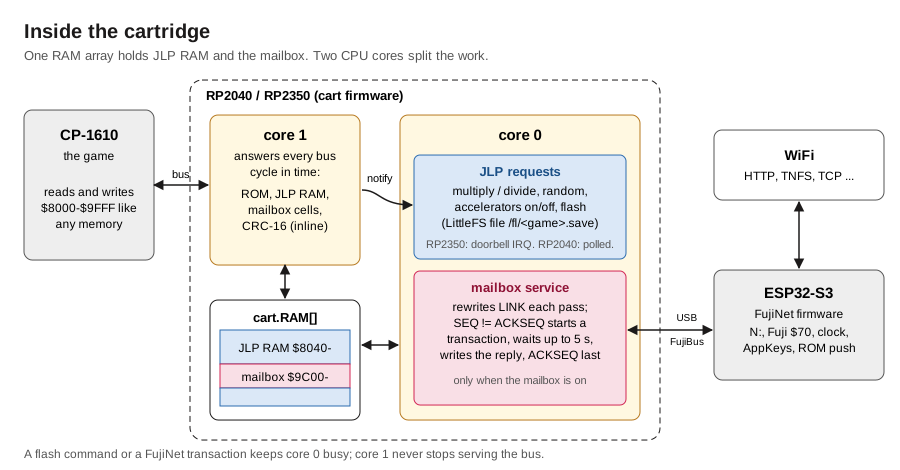
Core 1 of the RP2040/RP2350 does nothing but answer the bus. It serves
reads and writes of JLP RAM and of the mailbox from the same array, and it
runs the CRC-16 step itself. Everything slower goes to core 0: the
multiply and divide results, refilling the random-number buffer, flash
commands (each a LittleFS file operation on the cart's own flash, in
/fl/<game>.save), and the mailbox service loop that ships requests to the
ESP32.
How core 0 hears about JLP work differs between the chips:
- RP2350 (the FujiNet INTV board): core 1 rings a doorbell interrupt on every JLP register access, so the accelerators answer even while core 0 waits for the ESP32.
- RP2040 (PiRTO II boards): core 0 checks for JLP work once per pass of its main loop. While it waits on a FujiNet transaction it doesn't check, so multiply/divide results and flash commands stall for up to the transaction's length. See Known issues.
A flash command keeps core 0 busy on both chips; the mailbox waits for it.
- Build with
intybasic --jlp. If you use flash, start withFLASH INIT SIZE n(IntyBASIC then emitsjlp = 3andjlpflash = n). - Opt in to the mailbox:
ASM CFGVAR "fujinet" = 1. as1600 copies it into the.cfg's[vars]. - Assemble to a
.bin+.cfg(as1600 -o game game.asm, no extension, writes both and a.rom) and put the.binand.cfgside by side on the FujiNet host. - Use a mailbox transport without the
ASM MEMATTR $8000, $9BFF, "+RWN"line the non-JLP FujiNet games carry. JLP already provides RAM there, and declaring[memattr]RAM under$8000-$9FFFstops the game from booting.src/fujinet.basis such a transport. - Keep every 16-bit variable below
$9C00. IntyBASIC only warns at$9F80, so it will happily put a largeDIMacross the mailbox. Look up_SYSTEM2in the.symfile; this repository'stools/check_map.pyfails the build for you. - Derive
SEQfrom the cart'sACKSEQ(ACKSEQ + 1, skipping 0), never from a counter of your own: a console reset restarts your program but not the cart. - Use
FLASH.FIRSTfor flash row numbers. It is 0 on the cart and 224 in jzIntv. And never point a flash command's RAM address at the mailbox.
-
IntyBASIC 1.4.2 vs 1.5. With
--jlp, 1.4.2 clears JLP RAM only up to its last variable at startup. 1.5.x clears all of$8040-$9F7F, which wipes the mailbox header, magic included. The mailbox still works (the cart rewritesLINKon every pass, so a write of$A5to$9C0Fturning back into 0 or 1 proves it is there), but a transport that waits for theF,Nmagic will give up. -
Turning the accelerators off.
$8034turns JLP's accelerators off and$8033back on. The mailbox keeps working either way. On the cart, JLP RAM stays visible while the accelerators are off if the game has flash; real JLP and jzIntv hide it. -
Multiplication is an accelerator access. With
--jlp, IntyBASIC compiles*by anything but a small constant,/andMODinto JLP register accesses. On an RP2040 cart that matters while a transaction is in flight (see above).
FujiNetWIFI's jzIntv models the cart since FujiNetWIFI/jzintv#3 (the FujiNet Go Intellivision apps follow):
- the FujiNet peripheral answers
$9C00-$9F3Fonly; - a JLP game keeps the mailbox only with
[vars] fujinet = 1in its.cfg, whether it is loaded from the command line or pushed by FujiNet, and JLP then stands aside on$9C00-$9F3F; - flash commands whose RAM span touches the mailbox are refused;
-
LINKis rewritten continuously, as on the cart.
Earlier builds registered the FujiNet peripheral over $9C00-$9FFF on top
of JLP. jzIntv's bus ANDs the readers of an address together, so with both
enabled the mailbox handshake never completed and the multiply/divide,
CRC and random-number registers read as zero. The test ROM shows exactly
that on an old build: A2 finds no mailbox, A5 and B8 fail because the high
JLP RAM reads back only 8 bits, and B2-B5 fail.
In jzIntv, the opt-in is read from a .cfg only, as on the cart: run the
.bin (jzIntv finds the .cfg beside it) to get the mailbox, or the .rom
to test JLP alone.
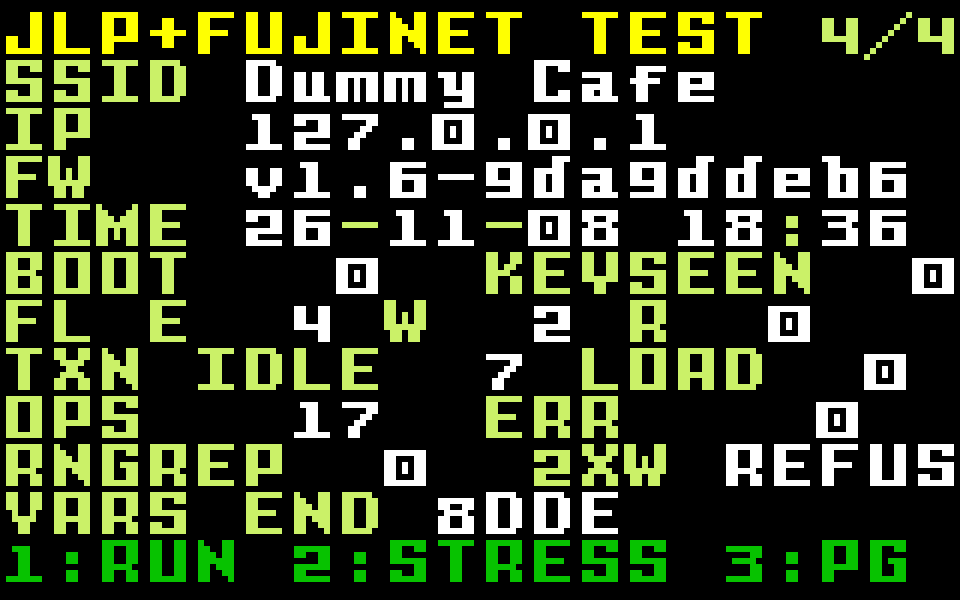
jlpfn.bin + jlpfn.cfg runs 24 tests at boot, ten to a
screen, then shows a details page. Results are PASS (green), FAIL (red),
SKIP (yellow) or INFO (white) with one measured value.
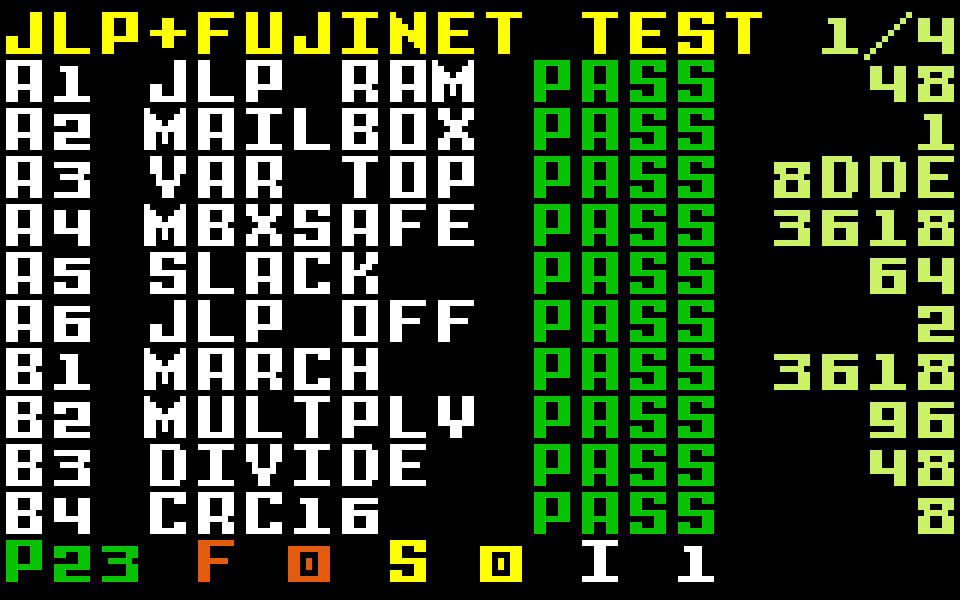
| Test | Proves |
|---|---|
| A1 JLP RAM | 16-bit JLP RAM is there, and flash has the 48 rows the .cfg asked for. Value: rows. |
| A2 MAILBOX | The mailbox answers inside the JLP window: magic F,N,1, and LINK comes back from $A5 to 0/1. SKIP: no mailbox (all FujiNet tests then skip). INFO: live, but its header was cleared. |
| A3 VAR TOP | IntyBASIC's 16-bit variables end below $9C00. Value: _SYSTEM2. |
| A4 MBXSAFE | Filling and checking every free JLP RAM word up to $9BFF leaves the mailbox header untouched and starts no transaction. |
| A5 SLACK |
$9F40-$9F7F, between the mailbox and the accelerators, is full 16-bit JLP RAM. |
| A6 JLP OFF | Accelerators off and on again: the mailbox stays visible and variables survive. Value: 1 = JLP RAM stayed visible while off, 2 = it read $FFFF. |
| B1 MARCH | Four address-dependent patterns through all free JLP RAM below the mailbox. |
| B2 MULTPLY | All four multiplies against a software reference, both result words, plus IntyBASIC's own *. |
| B3 DIVIDE | Signed and unsigned divide, quotient and remainder, plus IntyBASIC's / and MOD. |
| B4 CRC16 | Known-answer vectors through the CRC unit (computed on the host by tools/mkpattern.py). |
| B5 RANDOM | 256 reads of $9FFE: not stuck, not repeating every 4 reads, not zeros. |
| B6 FLASH | Erase, write and read back rows in two sectors, timed. Also writes one row twice without erasing and records what happened (details page). |
| B7 ERASE | Erasing row 8 erases sector 1 and leaves sector 0 alone. |
| B8 RANGE | A flash read whose 96-word destination runs past $9F7F is refused. |
| B9 BASICFL | The same round trip through IntyBASIC's FLASH statements. Skipped if any command above read its key back, which would crash IntyBASIC's flash routine. |
| C1 WIFI | Fuji $FA: WiFi connected (3). |
| C2 ADAPTER | Fuji $C4: the 240-byte adapter config (SSID, IP and version on the details page). |
| C3 CLOCK | Clock device $45, command $93: a plausible date and time. |
| C4 APPKEY | Writes 64 fresh bytes to AppKey $0909/$03/$00 and reads them back. SKIP if the FujiNet has no SD card. |
| C5 HTTPGET |
N: downloads data/pattern.bin (3,072 bytes) into JLP RAM, checking every byte, plus a software CRC of the whole. |
| D1 ASYNC | The same download with JLP work (RAM, multiply, divide, CRC, random) running for as long as each READ is in flight, every result checked. Value: JLP operations done during transactions. |
| D2 NET CRC | The JLP CRC unit, fed the downloaded words, produces the CRC the host computed for the file. |
| D3 NET>FL | The downloaded data to flash (16 rows), read back, compared; then a header row. Value: frames. |
| D4 PERSIST | Run at boot: the previous run's D3 data is still in flash and its CRC checks. Value: boot count. INFO on the first boot. |
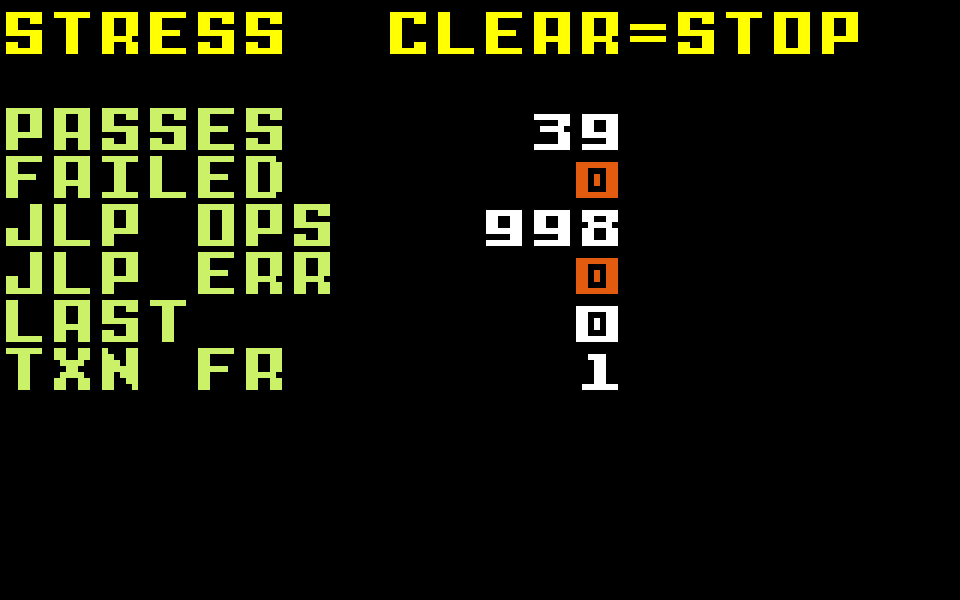
Keypad: 1 runs everything again, 2 starts the stress loop (D1-D2 repeatedly, through flash every eighth pass, until CLEAR), 3 or the disc turns the page.
Found while writing the test ROM. Each has a test that shows it.
| Issue | Where | Test | Status |
|---|---|---|---|
Flash erase picks the sector as row % 8 instead of row / 8: erasing rows 8-15 erases sector 0 |
cart firmware | B7 | #2335, in review |
| Flash row and RAM address are not range-checked; a span can overwrite the accelerators or the mailbox | cart firmware | B8 | #2335, in review |
| RP2040 carts serve JLP accelerators and flash only between core-0 loop passes, so results go stale and flash stalls during a FujiNet transaction | cart firmware | D1, B9 | fix in progress |
| jzIntv put the mailbox on top of JLP | jzIntv | A2, A5, B2-B5 | fixed in jzintv#3 |
jlp = 2 means "accelerators off at reset" to jzIntv and JLP, "on" to the cart |
cart firmware | — | open |
An Intellicart .rom booted over the network gets no JLP |
cart firmware | — | open |
| The cart lets a flash row be written twice without an erase; JLP and jzIntv refuse | cart firmware | B6 (details) | open |
A JLP game without flash that turns the accelerators off can't turn them back on: the cart drops the $8033 write |
cart firmware | — | open |
IntyBASIC 1.5 --jlp clears the mailbox at startup; on a console reset the cart can replay the last command |
IntyBASIC / cart | A2 | open |