GG20B - FresnoSubber/Fresno-and-Co.-Trainbuild-Tomfuckery GitHub Wiki
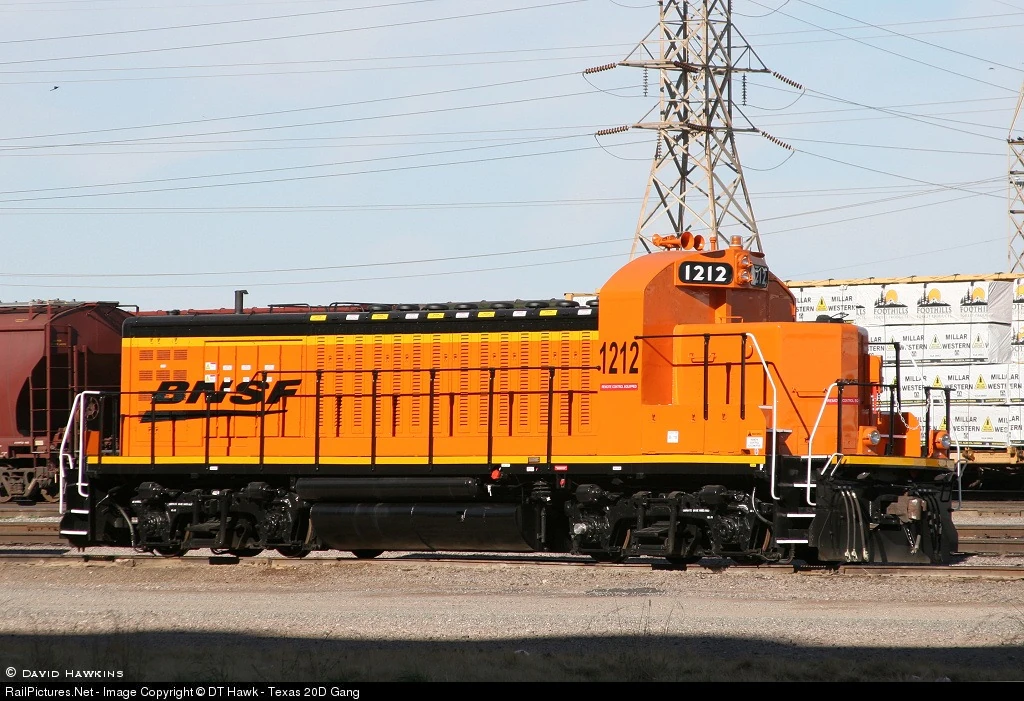
BNSF was weird with these things lol. This was just a BNSF thing only. Converted from a BN GP9, this unit is at BNSF’s North Yard. Photo Credit: David Hawkins
The whole point of Railpower was to revolutionize rail transport with the concept of Hybrid locomotives using a diesel generator and a battery bank. They were one of, if not, the first North American locomotive manufacturers to do this, starting with the GGS2000D, which could be considered the predecessor to the GG20B. Only difference was that the long hood was made higher for a taller generator and more batteries, and, of course, the cab (which BNSF opted not to have them lol!!!! funny!!!!).
The GG20B was, of course, not as successful as other Railpower products like the RP20BD with 55 examples. Probably because battery technology was less developed then (hint hint it still is. i’m looking at you class ones).
It was so meh that CP literally cancelled their order, and their engines ended up on Amtrak, BNSF, Railpower themselves, and the US Army.
UP ditched theirs during the mid-2010s, BNSF and KCS converted theirs to RP14BDs, and CSX, NS, and CN actually were all smart for once (major NS W for the time) and didn’t get any.
Of course though this wasn’t it, as GE and later Progess Rail, and even Union Pacific again in 2024, would experiment with this. knowing Progress Rail, they’re gonna kill hybrid technology like how they killed the Genset trend. Fuck Progress Rail.
Oddly, BNSF turned their Ex-CP Green Goat to a Hydrogen test bed, the HH20B. It’s preserved at the Oklahoma Railway Museum in Oklahoma City, having been so since mid-2023, not only marking the first Hydrogen Fuel Cell Locomotive preserved, but also, so far, only one of two Railpower locomotives currently preserved.

The BNSF Hydrogen test unit. Photo Credit: Nathan Zachman
Technical Specifications
| General Info | - |
|---|---|
| Prime Mover | Caterpillar C9 (1) |
| Horsepower | 2000 (2) |
| Truck Type | Blomberg B (3) |
| Axles | 4 |
| Traction Motors | 4 |
| Minimum Weight | 238,000 lbs (4) |
| Maximum Weight | 280,000 lbs (4) |
| Model Base Speed | 65 MPH |
| Top Speed | 65, 70, or 86 MPH |
| Electrical System | - |
|---|---|
| Battery Max Current | 1200 Amps ⚠️ (5) |
| Max TM Current | 1500 Amps (5) |
| Max Continuous TM Current | 900 Amps (5) |
| Traction Motor Type | DC |
| Adhesion | 25% (6) |
| Transition Mode | Automatic with no Selector |
| Transition Groups | 1 |
| Transition Shunts | 1 |
| Generator Transition | Yes |
| Traction Control | ETC |
| Dynamic Braking Mode | does it look like batteries can do dynamics yet |
| DB Max Current | N/A |
| DB Max Continuous Current | N/A |
| Blended Braking | No |
| Miscellaneous | - |
|---|---|
| Head-End Power (HEP) | seems a little more viable but no |
| HEP Power Consumption | N/A |
| HEP Standby/Run Mode | N/A |
| Load Ramp Speed | 5 Amps/Tick ⚠️ |
| TM Overload Protection | No |
| Start Mode | Fully Automatic Start |
| Air Brake Schedule | 26-L |
| Compressor CFM | 159 (Atlas GAR37 @ 2750 RPM) |
| Main Air Reservoir | 35 Cubic Feet ⚠️ |
Notes:
(1): It’s more the batteries doing the work. The engine meanwhile acts more as a generator.
(2): Batteries give the locomotive this horsepower.
(3): If your base model is a Dash 7, use FB-2s.
(4): If your base model is a Dash 7, the minimum weight would be 253,000 LBS, and maximum 280,000
(5): Okay. This one’s a doozy. For FB2 Traction Motors, 1776 Max TM Max Current, and 1370 for Max Continuous TM Current. The Generator doesn’t exist for the batteries do it. Big whoop. Wanna fight about it?
(6): Adhesion is 33.5% for the FB-2.