The Imitation Game - Falmouth-Games-Academy/comp250-wiki GitHub Wiki
A computer would deserve to be called intelligent if it could deceive a human into believing that it was human, ~ A.M Turing
In 1950 Alan Turing posed a question in his paper computing machinery and intelligence. The question "Can machines think?"1 while a very simple question even now almost 70 years later we still do not have a definitive answer.
"The new form of the problem can be described in terms of a game which we call the ' imitation game '. It is played with three people, a man (A), a woman (B), and an interrogator (C) who may be of either sex. The interrogator stays in a room apart from the other two. The object of the game for the interrogator is to determine which of the other two is the man and which is the woman. He knows them by labels X and Y, and at the end of the game he says either ' X is A and Y is B ' or ' X is B and Y is A'. The interrogator is allowed to put questions to A and B thus: C : Will X please tell me the length of his or her hair ? Now suppose X is actually A, then A must answer. It is A's object in the game to try and cause C to make the wrong identification. His answer might therefore be ' My hair is shingled, and the longest strands are about nine inches long.' In order that tones of voice may not help the interrogator the answers should be written, or better still, typewritten. The ideal arrangement is to have a teleprinter communicating between the two rooms. Alternatively the question and answers can be repeated by an intermediary. The object of the game for the third player (B) is to help the interrogator. The best strategy for her is probably to give truthful answers. She can add such things as ' I am the woman, don't listen to him t' to her answers, but it will avail nothing as the man can make similar remarks. We now ask the question, ' What will happen when a machine takes the part of A in this game ?' Will the interrogator decide wrongly as often when the game is played like this as he does when the game is played between a man and a woman ? These questions replace our original,' Can machines think ? '"1
There are two main methods of training artificial intelligence, machine learning which teaches the computer to complete a task to great efficiency, and deep learning which accomplishes the same aim with greater flexibility due to the use of neural nets so simulate the human brain.
Machine learning can be defined as "The capacity of a computer to learn from experience, i.e. to modify its processing on the basis of newly acquired information."2, what this means is that machine learning works by adapting as the system is presented with new information. The system then utilises this information as to 'learn' through completing the same task multiple times, attempting to increase it's score each time. Machine learning can be split into three main categories supervised learning, unsupervised learning and reinforcement learning 3.
Deep learning makes use of deep neural nets to facilitate machine learning. It is often applied to research tasks looking more at general purpose AI over AI designed for a task3. DNNs or Deep neural networks can be used to do things such as speech synthesis 4 5 as well as use in a large number of other fields.6
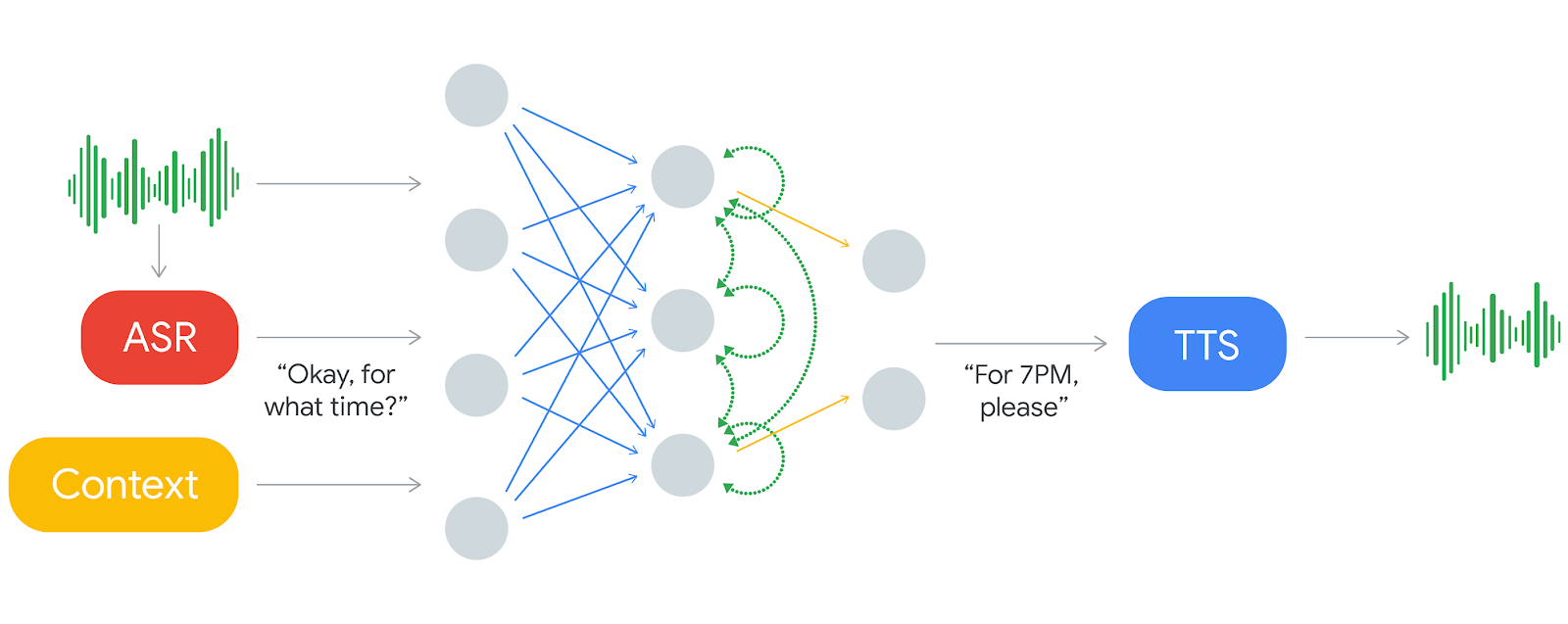
In 2018 for the first time a computer won the imitation game and passed the Turing test. The computer in question is the Google Duplex 5. Duplex is a computer designed to take appointment calls for people to save on labour and allow people to not get stuck in call ques5. Duplex is an incredibly advanced system that is able to pass for a human pausing and exclaiming like a real person during the call. To do this Duplex makes use of deep neural networks5 7.
1 A.M. Turing, Computing Machinery and Intelligence. Mind, vol.59, no. 236, pp.433-460, 1950
2 Oxford English Dictionary, Oxford University Press, 2017
3 C.Rodgers, Research Journal Based On A.M. Turing, Computing Machinery and Intelligence, Falmouth University ,2018
4 Z. Ling, L. Deng, D. Yu, Modeling spectral envelopes using restricted boltzmann machins and deep belief networks for statistical patametric speech sythesis, Audio, Speech, and Languange Processing, vol. 21(10), pp. 2129-2139, 2013.
5 Y. Leviathan, Google Duplex: An AI System for Accomplishing Real-World Tasks Over the Phone, Google AI Blog, 2018
6 H.Yi, D.Xiusheng, S. Shiyu, C.Zhigang, A Study on Deep Neural Networks Framework, IEEE Advanced Information Management, Communicates, Electronic and Automation Control Conference (IMCEC), 2016
7 G. Hinton, S. Osindero, YW.Teh, A fast learning algorithm for deep belief nets, Neural Computation, vol. 18(7), pp. 1527-1554, 2006.