Results - Avesta-Ahmadi/Univariate-Time-Series-Forecasting GitHub Wiki
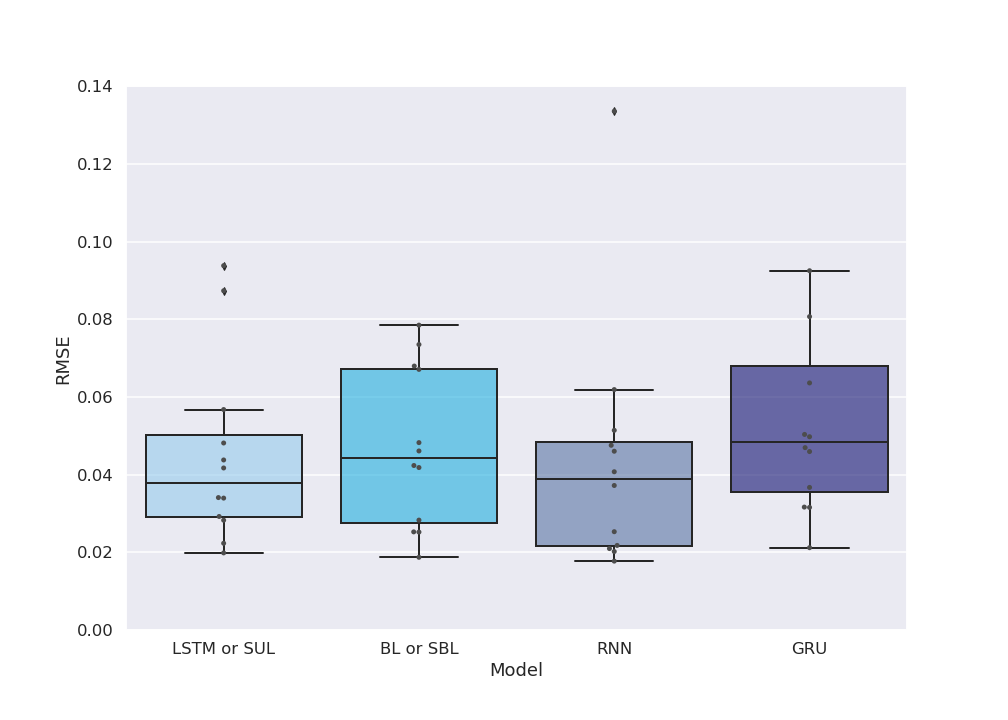
11 different univariate time series datasets have been used in order to compare all classical and deep learning approaches in time series forecasting. RMSE (root mean squared error) have been used as the metrics to compare all methods. First, the memory based approaches have been compared to each other. The Y axis is the RMSE and the X axis represents different methods. Box plots demonstrate how data is scattered. As can be observed, all memory based approaches perform well, with slightly better results for LSTM models.
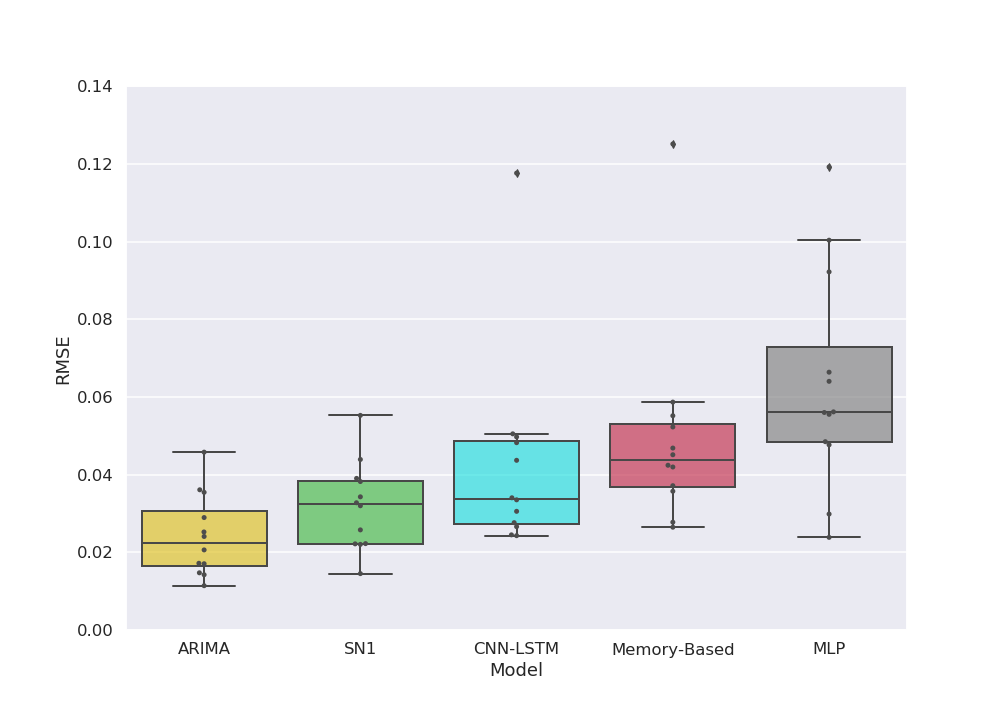
In the second figure, all methods have been compared to each other. As can be observed, SeriesNet outperforms all deep learning approaches and ARIMA models are performing the best.
Highlighting pros and cons of different approaches:
- Deep learning algorithms have no assumptions about the mapping function (linear or nonlinear). They are robust to noise in input data (learning in the presence of missing values).
- Deep learning algorithms can support an arbitrary but fixed number of inputs and outputs in the mapping function, Hence, providing direct support for multivariate prediction and multi-step forecasts.
- Data decomposition (prior deseasonalization) step should be employed prior to analysis for neural networks. Convolution based schemes are better at modelling seasonality.
- Dilated Causal Convolutions are designed to capture long-range dependencies effectively along the temporal dimension.
- Deep learning models often suffer from outlier errors for certain time series.