Providing A Service Using Astrix And GigaSpaces - AvanzaBank/astrix GitHub Wiki
This is a step by step tutorial that show how to provide a simple service using Astrix and GigaSpaces. A complete example is located in the tutorial folder.
Astrix uses a declarative programming model where the programmer typically uses annotations to express thing such as:
-
AccountServiceis a remote service that is discovered using the service registry - This application exports a remote service endpoint for
AccountService
Based on such metadata the Astrix Framework will run service discovery against the service registry when a consumer requests an instance of AccountService, or register with the service registry that the current application provides AccountService using Astrix-remoting over GigaSpaces. That is, the programmer expresses "what", and Astrix knows "how".
Every API provided using Astrix begins with an ApiProvider. An ApiProvider defines what beans are part of an API and how Astrix will create an instance of each corresponding type at runtime. Similarly an ApplicationDescriptor defines what services a given server exports, and how these services can be invoked. The following example shows how to implement an ApiProvider and an ApplicationDescriptor for a simple trading API.
The API has the following layout:
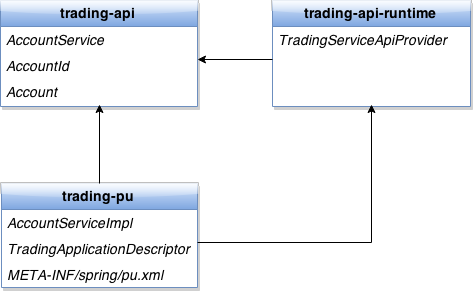
The API consists of an Account representation, a corresponding id type (AccountId), and a service (AccountService). Each is a regular POJO with one Astrix specific exception. The @AstrixRouting annotation tells Astrix that invocations to AccountService should be routed on the AccountId argument in a partitioned environment:
package se.avanzabank.trading.api;

public interface AccountService {
	Account getAccount(@AstrixRouting AccountId accountId);
}In order to consume AccountService using Astrix there must exist an ApiProvider that exports AccountService as an Astrix bean. Bean is the name used by Astrix for each type that is exported as part of an API. There are two types of beans, library and service. We won't go into the details about the difference between the two, but remoting services are typically exported as service beans.
For the trading-api the ApiProvider looks like this:
package se.avanzabank.trading.api.runtime;

@AstrixApiProvider
public interface TradingServiceApiProvider {
	@Service
	AccountService accountService();
}
The @AstrixApiProvider annotation identifies an ApiProvider. Astrix uses classpath scanning to find all ApiProvider's on the classpath.
TradingServicApiProvider exports AccountService by defining a method with AccountService as return type and annotating it with @Service, which tells Astrix how to bind to an instance of the given bean:
- Discover the service using the service registry
- Use information from service discovery to bind to the service
The service registry is an application that allows applications to register what services they provide, and to discover providers for a given service.
The last module is the server, in this case in the form of a GigaSpaces processing unit. An Astrix server is defined by an ApplicationDescriptor. For the trading-pu it looks like this:
@AstrixApplication(
	exportsRemoteServicesFor = TradingServiceApiProvider.class,
	defaultServiceComponent = AstrixServiceComponentNames.GS_REMOTING
)
public class TradingApplicationDescriptor {
}
The TradingApplicationDescriptor defines two things:
- That the given server provides remote services for each service defined in
TradingServiceApiProvider - That the default mechanism to export a service is Astrix remoting using GigaSpaces as transport.
An
ApplicationDescriptorcan be seen as the server side counterpart to anApiProvider. While anApiProviderdefines what beans are part of an api and how instances of these are created, anApplicationDescriptordefines what services a server provides, and how these can be invoked.
Astrix delegates incoming service invocations to AccountService to a corresponding implementation. In order for Astrix to find an implementation of AccountService it has to be annotated with @AstrixServiceExport:
package se.avanzabank.trading.pu;

@AstrixServiceExport(AccountService.class)
public class AccountServiceImpl implements AccountService {
	// Implementation
}
During startup of the trading-pu Astrix will register with the service registry, announcing that it provides AccountService using "GS_REMOTING". Astrix scans all spring beans on startup and collects @AstrixServiceExport annotated beans. These beans will be used at runtime to dispatch incoming service invocation to the corresponding service implementation.
The last piece in the puzzle exists in pu.xml (the spring application context configuration file). The spring bean AstrixFrameworkBean loads the Astrix framework. The applicationDescriptor property identifies that the current application is a server. When that property is set the server part of the framework will be loaded and all services defined in TradingApplicationDescriptor will be provided. For the trading-pu Astrix will start a background thread that periodically registers the server in the service registry, and load all classes required to export the provided service using the defined ServiceComponent.
<?xml version="1.0" encoding="UTF-8"?>
<beans xmlns="http://www.springframework.org/schema/beans"
	xmlns:xsi="http://www.w3.org/2001/XMLSchema-instance"
	xmlns:context="http://www.springframework.org/schema/context"
	xmlns:os-core="http://www.openspaces.org/schema/core"
	xsi:schemaLocation="http://www.openspaces.org/schema/core http://www.openspaces.org/schema/core/openspaces-core.xsd
		http://www.springframework.org/schema/beans http://www.springframework.org/schema/beans/spring-beans.xsd
		http://www.springframework.org/schema/context http://www.springframework.org/schema/context/spring-context.xsd">

	<context:annotation-config/>
	<os-core:space id="space" url="/./trading-space"/>
	<os-core:giga-space id="gigaSpace" space="space"/>

	<bean class="com.avanza.astrix.spring.AstrixFrameworkBean">
		<property name="applicationDescriptor"
			 value="se.avanzabank.trading.pu.TradingApplicationDescriptor"/>
	</bean>
	<bean class="se.avanzabank.trading.pu.AccountServiceImpl"/>

</beans>
Each client that want to consume the Trading API has to create an AstrixContext and use it as a factory to create instances of the beans that are part of the api. There are two ways to create an AstrixContext. The first one is to use an AstrixFrameworkBean as in the pu.xml above, which will create an register an AstrixContext in the current spring application context. The other option, most used in unit testing, is to create the context using an AstrixConfigurer:
AstrixConfigurer configurer = new AstrixConfigurer();
configurer.set(AstrixSetting.SERVICE_REGISTRY_URI,
	"gs-remoting:jini://*/*/service-registry?groups=elilin");
AstrixContext context = configurer.configure();
AccountService accountService = context.getBean(AccountService.class);
Astrix allows for a lot of configuration, see the AstrixSettings class. In practice you always have to define where the service registry is located by setting the AstrixSettings.SERVICE_REGISTRY_URI, see Service Discovery and Service Binding for more information about serviceUri's. Also, in order for Astrix to find the TradingServiceApiProvider it must be configured to scan the appropriate part of the classpath (by default it only scans the com.avanza.astrix package). This can be configured in the same way as the serviceUri for the service registry, but since the package name for an ApiProvider doesn't change between different environments the recommended way to configure scanning is by creating a META-INF/astrix/settings.properties and put it in a shared jar. The META-INF/astrix/settings.properties allows overriding of the default value for each Astrix settings, for instance the base package used when scanning for ApiProvider's:
AstrixApiProviderScanner.basePackage=se.avanzabankThats it, now you now the mechanics for providing and consuming a service using Astrix.