Offset GPS Time - ASPRSorg/LAS GitHub Wiki
This page provides a brief overview of Offset GPS Time and provides recommendations for semi-standard Offset Time values that can be used in LAS 1.5 to encourage consistency and compatibility between LAS datasets.
Justification
Adjusted Standard GPS Time as defined in LAS 1.2 through LAS 1.5 has been losing precision since 2011. In fact, it has been unable to designate timestamps with 0.1-microsecond precision (~8 MHz) since 2015, and it will be unable to differentiate past 0.2-microsecond precision (~4 MHz) in 2028. (Figure 1)
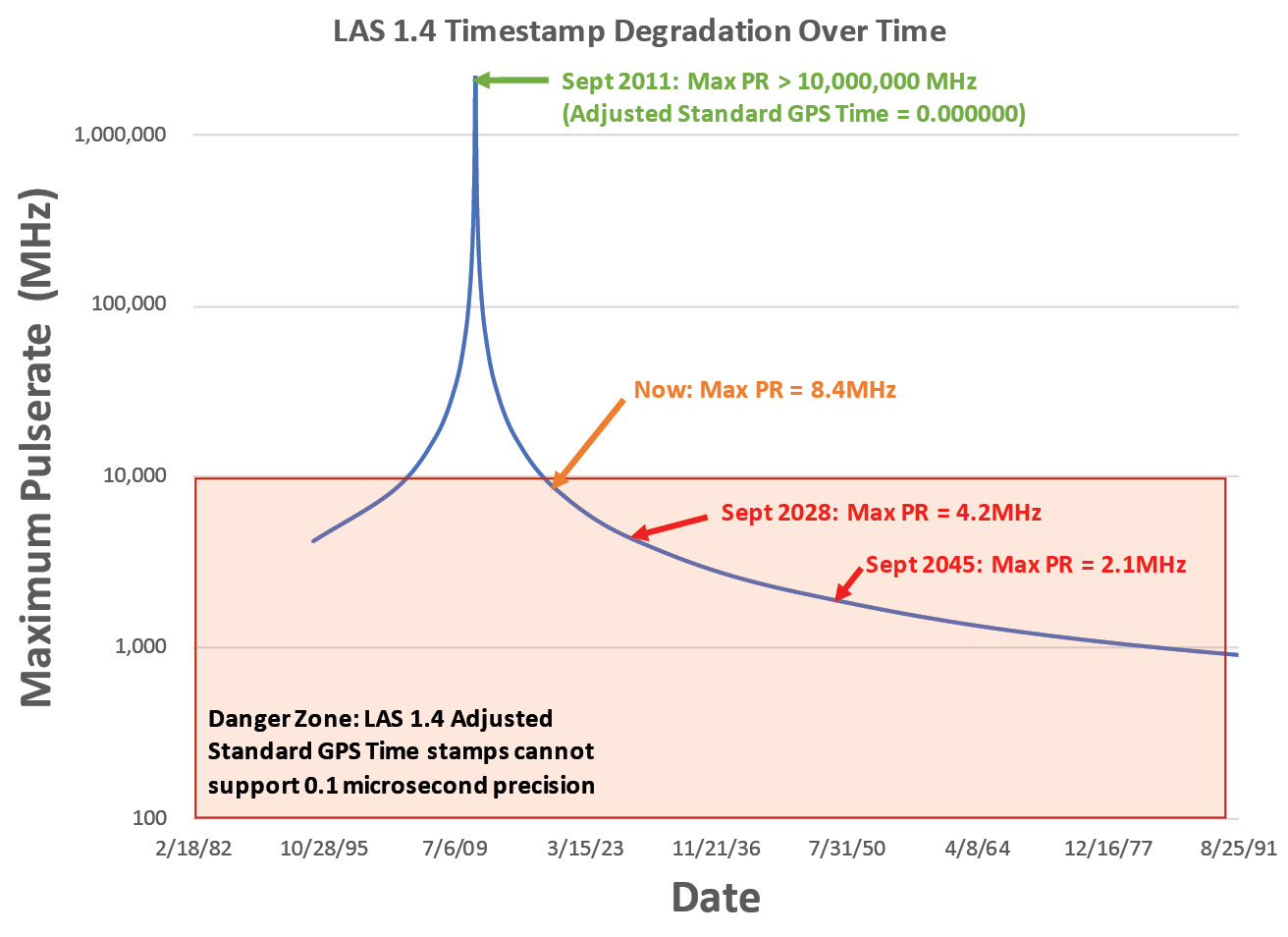
Given that 2-MHz sensors have been on the market since the early 2020s, it may already be technically impossible to differentiate between pulses using Adjusted Standard GPS Time.
Offset GPS Time was introduced in LAS 1.5 (#6) to provide a simple methodology to address this loss of precision over time without breaking compatibility with past versions of LAS, while also remaining easy for software vendors to implement.
Recommended Offset Time Values
The Offset GPS Time encoding provides the flexibility to enable 0.1-microsecond precision (or better) for any 8-year period, which would be optimal for a system with a 10MHz or lower pulserate.
In order to maximize compatibility between datasets covering similar time periods, the LWG recommends using standardized values incrementing by 250 million. This increment optimizes GPS Time precision to approximately 100 nanoseconds (0.1 microseconds) for a given 8 year period.
A table of recommended standard offset values is provided below to promote standardization and simplify integration of datasets collected by a variety of vendors.
| Offset Time | Offset Value | Optimal Year Range | Notes |
|---|---|---|---|
| 500 | 500,000,000 | 1991-2000 | |
| 750 | 750,000,000 | 1999-2008 | |
| 1000 | 1,000,000,000 | 2007-2015 | Adjusted Standard GPS Time Offset |
| 1250 | 1,250,000,000 | 2015-2023 | |
| 1500 | 1,500,000,000 | 2023-2031 | Current recommendation (2025) |
| 1750 | 1,750,000,000 | 2031-2039 | |
| 2000 | 2,000,000,000 | 2039-2047 |
Conforming to the values above is not a requirement for a file to be considered a valid LAS 1.5 file, but rather a recommendation.