PRODUCT ARCHITECTURE - A-Division-2018-2019/Team-13 GitHub Wiki
User system interaction
| User | System |
|---|---|
| Insert veil | Hold the veil |
| Accept veil | |
| Select the type of folding | Accept the type of folding |
| Fold the veil | |
| Dispense veil |
| Below are the identified and prioritised objectives |
|---|
| 1. User friendly |
| 2. Safety |
| 3. Fold veil neatly |
| 4. Cost effective |
| 5 .Portable |
| 6. Semi-automated |
Assign weightage for the stated objectives
| objectives | weightage |
|---|---|
| User friendly | 9 |
| Safety | 8 |
| Fold veil neatly | 7 |
| Cost effective | 7 |
| Portable | 6 |
| Semi-automated | 5 |
| Designs |
|---|
| Design 1:- Twisting veil. |
| Design 2:- Flap folding veil |
| Design 3:- Rolling veil |
| Design 4:- Alternate folding pattern |
| Design 5:- swirling |
| Design 6:- Rectangular rolling |
PUGH CHART
| Objectives | design 1 | design 2 | design 3 | design 4 | design 5 | design 6 |
|---|---|---|---|---|---|---|
| User friendly | Datum | 0 | 0 | - | 0 | + |
| Safety | Datum | + | + | + | 0 | - |
| Fold veil neatly | Datum | -- | -- | 0 | + | + |
| Cost effective | Datum | + | + | - | - | 0 |
| Portable | Datum | 0 | + | + | - | 0 |
| Semi-automated | Datum | - | 0 | + | + | + |
| + Score | 0 | 15 | 21 | 11 | 12 | 29 |
| - Score | 0 | 19 | 14 | 24 | 13 | 0 |
| Total | 0 | -4 | 7 | -13 | -1 | 29 |
The best concept is Design 6
Justifications
| Design no. | Objective | score given | Justification |
|---|---|---|---|
| User friendly | 0 | ||
| Safety | 0 | ||
| Fold veil neatly | 0 | ||
| 1 | Cost effective | 0 | Because it is used as datum |
| Portable | 0 | ||
| Semi-automated | 0 | ||
| ---- | ------------ | --- | --------- |
| User friendly | 0 | Because it is easy to place veil | |
| Safety | 8 | There is no risk of injury to hand | |
| Fold veil neatly | -14 | when flaps are folded, it may not fold veil propely | |
| 2 | Cost effective | 7 | There are no complex devices used |
| Portable | 0 | Because it may weigh same as design 1 | |
| Semi-automated | -5 | We may need to fold flaps manually | |
| ---- | ------------ | --- | --------- |
| User friendly | 9 | Because it will roll automatically due to motors | |
| Safety | 8 | Because it will not harm our hand | |
| Fold veil neatly | 7 | It will roll veil neatly by itself in one stretch | |
| 3 | Cost effective | 0 | Because it may cost same as design 1 |
| Portable | 0 | It may weigh same as design 1 | |
| Semi-automated | 5 | Because it rolls veil by itself | |
| ---- | ------------ | --- | --------- |
| User friendly | -9 | Because it is difficult to place veil correctly | |
| Safety | -8 | while entering veil it may harm our hand | |
| Fold veil neatly | 0 | It may be same as design 1 | |
| 4 | Cost effective | -7 | It may cost more because complex folding frames need to be used |
| Portable | 6 | It may weigh less if plastic frames are used | |
| Semi-automated | 5 | Because once we place veil it will fold automatically | |
| ---- | ------------ | --- | --------- |
| User friendly | 0 | Because the placing mechanism is same as datum | |
| Safety | 0 | Here also we have to place the same way | |
| Fold veil neatly | 7 | Swirling is more neat folding method for veil than datum | |
| 5 | Cost effective | -7 | Because cost of devices used may be high |
| Portable | -6 | Because of many motors and other devices it may weigh high | |
| Semi automated | 5 | Because it will do all swirling and placing operation by itself | |
| ---- | ------------ | --- | --------- |
| User friendly | 0 | Because placing veil takes same effort as in datum | |
| Safety | 8 | Because we have to just place veil on the platform | |
| Fold veil neatly | -14 | Because when flaps fold it will not assure that veil will fold properly along with it | |
| 6 | Cost effective | 7 | Because no much complex mechanism used in this |
| Portable | 6 | Because flaps will not weigh much | |
| Semi-automated | 0 | Because datum and this design are same in this case |
Function Tree
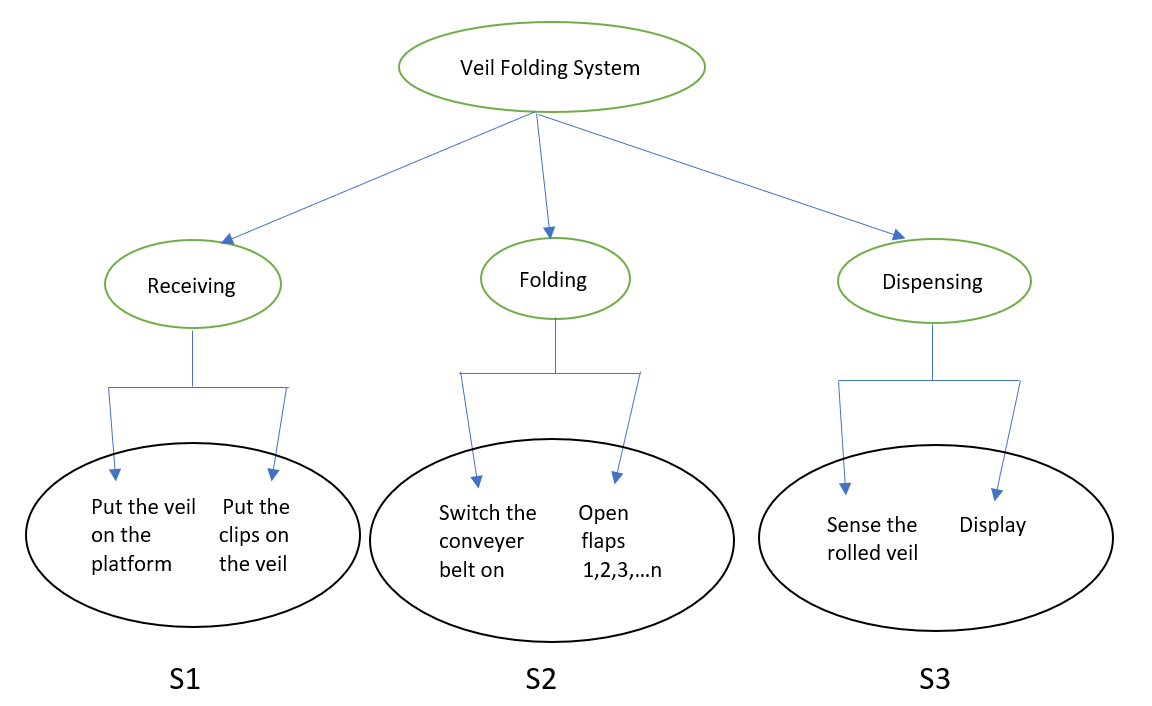
| Sl.no | Sub function |
|---|---|
| S1 | Receiving veil by the means of clips |
| S2 | Folding veil by means of flaps |
| S3 | Dispense veil by means of a suitable dispenser |
System Interaction
| Interaction | S2 | S3 | |
|---|---|---|---|
| Data | ✔ | ❌ | |
| S1 | Material | ✔ | ✔ |
| Energy | ✔ | ❌ | |
| Spatial | ✔ | ❌ |
Table 1
| Interaction | S1 | S3 | |
|---|---|---|---|
| Data | ✔ | ✔ | |
| S2 | Material | ✔ | ✔ |
| Energy | ❌ | ❌ | |
| Spatial | ✔ | ✔ |
Table 2
| Interaction | S1 | S2 | |
|---|---|---|---|
| Data | ❌ | ✔ | |
| S3 | Material | ❌ | ✔ |
| Energy | ❌ | ❌ | |
| Spatial | ❌ | ✔ |
Table 3
Justification
| Sub-function | Interaction | Explaination |
|---|---|---|
| Data | the veil is accepted and signals are sent to S2 | |
| S1->S2 | Material | veil is transferred |
| Energy | Energy in the form of motor activation | |
| Spatial | the cliffs that are present on the flaps which will receive and fold the veil | |
| ---- | ---- | ---- |
| Data | No data is sent directly | |
| S1->S3 | Material | The veil flows from S1 to S3 through S2 |
| Energy | No energy is sent | |
| Spatial | they are not connected by any hinges or cliffs |
Table 1
| Sub-function | Interaction | Explaination |
|---|---|---|
| Data | From S1, S2 receives data such as the veil is clipped | |
| S2->S1 | material | Veil is received |
| Energy | No energy is received | |
| Spatial | Connected as clips are placed on flaps | |
| ---- | ---- | ---- |
| Data | Dispensing system is activated | |
| S2->S3 | material | Veil is sent |
| Energy | No energy is sent | |
| Spatial | Dispenser and folding flaps are connected by hinges and screws |
Table 2
| Sub-function | Interaction | Explaination |
|---|---|---|
| Data | no data is sent | |
| S3->S1 | Material | veil is sent from S1 to S3 then S2 |
| Energy | No energy is sent | |
| Spatial | Dispensing systems etc are interconnected | |
| ---- | ---- | ---- |
| Data | S2 initializes the dispensing system | |
| S3->S2 | Material | From S2 veil flows to S3 |
| Energy | There is no transfer of energy | |
| Spatial | S3 and S2 are interconnected as S2 is folding and S3 is dispensing system which is immidiate next function |
Table 3
LIST OF COMPONENTS USED
| The components used are |
|---|
| LDR sensors |
| Relay |
| flaps |
| clamps |
| Limit switches |
| Arduino |
| Motors |